
Captain John's Sailing Tips
Newsletter #126 ~ November 12, 2011
In Today's Issue:
* It's Your Call, Skipper!
* Sailing Skills Video-of-the-Week
* New Skippertips Site Launch Coming in November!
* New eBook "Sailing Emergencies Take-Action Guide!"
* Did You Miss the Latest Member's Articles?
* Sailing Skipper's Quotable Quotes
========================================================================
"It's Your Call, Skipper!"
Is Your Emergency "Initial Action" Plan Ready?

to deal with the unexpected when it crosses your path...
like a blown hose on a seacock or a fracture in your hull?
Read this excerpt from the soon to be released eBook...
"Sailing Emergencies "Take-Action" Guide"...
to discover some of the techniques you'll want to add...
to your treasure-chest of knowledge for sailing safety.
~~~~~~~~~~~~~~~~~~~~
What initial "first line" action will you take if a hose blows off the top of a seacock--and the handle freezes in the open position?
Or all of a sudden you hear a thud in the middle of the night--and water pours in from a crack in your hull. Take action fast, be aggressive, and use the materials you have aboard.
Install this #1 Flooding Tool First
The force of sea water flowing through a hole or fracture will be enormous. Imagine that you turn on a garden hose full force. Now try to drive a wooden plug into the end of the hose with just your hand.
Use a heavy hammer or mallet to drive plugs or patches (see below) into or over a hole or fracture. The heavier the better. In the Coast Guard, we used sledge hammers in live training exercises. Swing a sledge hammer in air--that's easy. Try that with water up to your waist, and it's like slow motion. Heavier gets the job done fast.
Mount your hammer or mallet in an open area, accessible to the crew. Like a fire extinguisher, your hammer must be easy to find day or night, in lighted or unlighted situations--not buried in a sail locker or tool box.
Follow the illustrations and steps below to keep control of any emergency that involves water intrusion into your boat:
How to Plug a Seacock!
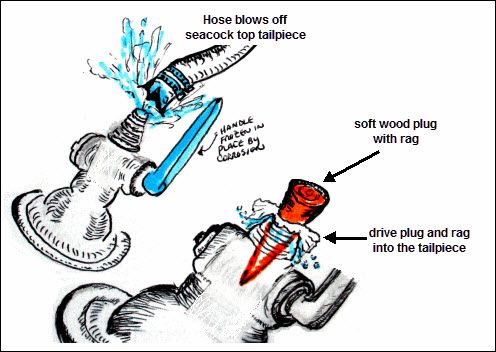
1. Practice prevention to avoid emergencies in the future. Exercise seacock handles (move them from the open to closed position several times) at least once a month to prevent corrosion (freezing in place).
Inspect seacock hoses for hardening or cracks. Install new hoses if you suspect weakness or lack of integrity. Inspect and replace corroded or rusted hose clamps.
2. Attach a soft-wood, tapered plug to each seacock. Use soft rags over the point to provide friction and fill cracks or gaps when you drive it in to the seacock tail-piece.
3. Monitor your repair to make sure water pressure doesn't blow the plug out. Keep a hammer or mallet nearby in case you need to drive the plug in further. If necessary, use the next illustration (see "How to Shore Up a Fractured Hull!" below) to strengthen your plug repair further.
How to Shore Up a Fractured Hull!
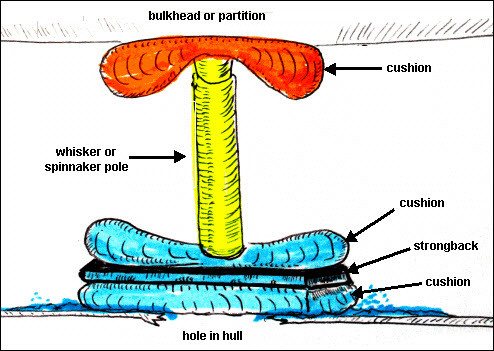
1. Make a "strong-back" over the hole. Any rigid or semi-rigid flat piece of material makes a good strongback. For example: hatch boards, access covers beneath berth cushions, spare plywood, a large clipboard.
Next, build a "strongback sandwich" (see illustration). Jam a cushion or pfd over the hole. Place the strongback over the cushion. Put a second cushion or pfd on top of the strongback.
2. Use a boat-hook, whisker-pole, or spinnaker-pole as a brace. Jam one end of the brace into the top cushion over the strong-back.
3. Hold a second cushion or pfd against the opposite side bulkhead. Jam the other end of your brace into this cushion.
Monitor Your Patch Repair
Assign a crew to monitor the patch to make sure it holds. Boats flex and vibrate underway, even in calm conditions--and that can cause your patch to shift. Water pressure against the patch will be quite high. Add more braces for additional support. Keep a heavy hammer or mallet close by to set your braces into position.
~~~~~~~~~~~~~~~~~~~~
Use these proven tactics to plug and patch a leak and get flooding under control. Gain the confidence you need to protect your small sailboat and crew in any flooding emergency with practice, planning, and positive initial action.
Excerpt from the brand new, eBook "Sailing Emergencies "Take Action" Guide" by Captain John--due for release next week. See more details below on this vital step-by-step guide that will show you fast and effective ways to handle sailing emergencies.
=========================================================================
Captain John's Sailing Skills Video-of-the-Week
Look at any nautical chart or chart plotter...
and you'll see wavy black lines near the coastline.
Did you know that you can use these with your depth sounder...
to keep your sailboat in safe water? Watch this new video now!
How to Use the Magic of Charted Depth Contours!
** Mobile Device Users**
Click on the link above. Click on the icon beneath the main screen.
Please allow 20 to 30 seconds for the video to upload.
=========================================================================
New Skippertips Site Launch Coming in November!

The site is undergoing a complete face-lift and updating. It will be easier to use and site navigation will be a snap. We expect roll-out before November 30, 2011.
As we test things, you may notice changes in panel widths, colors, banners, or links.
This should not interfere with your ability to browse or use the site in any way. Shoot me an email right away if you experience any problems. That way, we can correct the issue as soon as possible. ~ Captain John.
=========================================================================
New eBook "Sailing Emergencies Take-Action Guide!"
We humans go into "auto-pilot" mode under super high stress. To be highly effective, our decisions on what to do and how to do it need to be already planted in our brains long before the situation arrives.
For example, let's say you spring a leak in your boat. It's not so important to stop the leak. But it's vital to slow the leak to such a degree that pumps or buckets can keep it under control without undue hardship on the crew.
This aggressive "initial action" will move the crisis from an emergency status to an urgent status. From there, you can handle it in a more relaxed manner.
That's what this eBook will show you. Preventative steps. Plus the steps to take that will help you get things under control fast. Drop-dead simple and effective. You will learn how to:
- Choose the tools to handle the sailing emergency.
- Create a solid "battle plan" to fight emergencies fast.
- Train your crew the fun, easy, safe way to keep them ready.
- Practice prevention with a little-known, super technique.
- Develop a powerful "sailor's mindset" to keep razor sharp.
- All this and much, much more!
Coming to SkipperTips members this Tuesday, November 15, 2011.
=========================================================================
Did You Miss the Latest Member's Articles?
 Five Learn to Sail Like a Pro - Are You Sailing Too Slow to Windward?
November 9, 2011 ~ Are you losing speed when you sail upwind? Do you know what you need to do to increase your speed of advance to your windward goal? Learn to sail a boat better than ever before with this nifty technique from sailing expert John Rousmaniere.
//www.skippertips.com/snip/773.htmSailing Five Marine Flare Steps Every Sailing Skipper Needs to Know!
November 8, 2011 ~ Are you sure you know how to use a flare gun, flare launcher, flare smoke, or flare parachute? You need to be familiar with all of these vital tools--before an emergency happens. You won't have time then!
//www.skippertips.com/snip/774.htm=========================================================================
Sailing Skipper's Quotable Quotes...
-- Charles F. Chapman In actual practice, piloting generally resolves itself down into the intelligent study of a chart.

========================================================================
Get Instant Access to 425+ sailing articles, videos, live discussion forums, and FREE eBooks! Click Here to Join! "SEAMANSHIP SECRETS"
from International Marine / McGraw-Hill
 "You will be in the hands of an experienced and trusted guide."
-- Daniel Spurr, world famous author and
former senior editor of Cruising World magazine"Written so clearly that navigation and seamanship will be comprehensible to anyone."
-- Dave and Jaja Martin, circumnavigators, authors and stars of the documentary "Ice Blink""It should be read by anyone contemplating
coastal cruising or blue water voyages."
-- Ted Brewer, world famous yacht designer, veteran ocean racing and cruising sailorCaptain John Shares 25+ Years of Experience to Show You How to...
- Complete 90% of your navigation--before you cast off the lines.
- Determine the best "window of opportunity" to transit any inlet.
- Enter an unfamiliar harbor after dark in complete confidence.
- Extend the trouble free service of any size inboard diesel engine.
- Balance any sailing vessel in heavy weather in three easy steps.
- Use "terrain effect" to forecast weather anywhere in the world.
- Control boat emergencies with a simple method called M-A-T-E.
All this and much more. 326 pages tailored to short-handed sailors and crews.
Easy to read and loaded with crystal clear illustrations. Get your copy today!Click On One of These Links to Order Now!
-
Amazon, Barnes & Noble, or Books-a-Million
 Five Learn to Sail Like a Pro - Are You Sailing Too Slow to Windward?
 "You will be in the hands of an experienced and trusted guide."