
Sailing Tips Secrets - How to Steer with Pinpoint Accuracy
Have you ever noticed how new sailing crew struggle to "keep the course" after only 2 to 3 minutes at the wheel or tiller? Did you know that there's a much easier, more accurate method? Learn the sailboat cruising secrets used by the pros on deliveries and long distance voyaging.
Can you imagine driving your car down the highway with your eyes glued to the speedometer? No one does this. Instead, you use a natural, built-in "judgment-meter" to know when to accelerate or decelerate. Once in a while, you glance at the speedometer to fine tune your progress.
Use this same principal with pick-a-point (P.A.P.) steering. Follow one of these three methods based on whether you sail in inland waters, along the coast or across an ocean, or during nighttime.
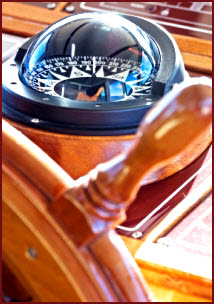
1. Steady up onto your compass course with the steering compass.
2. Glance ahead, pick a distant object, and steer on it. Superimpose the object against some fixed part of your small cruising boat (mast, stay, shroud, pulpit, stanchion).
3. Check your steering compass every 30-45 seconds. A quick glance should be enough. Repeat steps 1 and 2 to fine tune your heading.
Coastal or Ocean P.A.P. Steering
1. Steady up onto your compass course with the steering compass. In seas, average your course above and below the sailing course (see related article link below). This causes less fatigue.
2. Pick a distant irregular land point if steering toward shore. This might be a hump, gap, or peak in a tree line,
group of hills, cliffs, or mountain range.
Line up a fixed object with a cloud at sea. Shift to a new cloud or group of clouds often. If clouds are absent, maintain a constant angle with wind-blown whitecaps, use shroud telltales, or feel the wind on your face. All of these methods help when you are out of sight of land.
3. Check your steering compass every 30-45 seconds. If you average your course, remember that you must keep an eye on your watch for accuracy.
Nighttime P.A.P. Steering
1. Steady up on your compass course, or use the course averaging method described in the related article link below.
2. Pick a star high up off of the horizon. Select a celestial body near the top of its arc. These stars move slower than those closer to your horizon. The exception are stars near the equator; they rise and set in a vertical motion. Place the star along your boat's mast, stay or shroud.
3. Check your compass every 30 to 45 seconds. Take care not to get lulled into following a star across the ocean! Keep away from planets (they look like steady lights without the "twinkle" that stars have). Planets move much too fast across the sky for steering accuracy.
As a sailing skipper, always be on the lookout for new ways to make your sailing crew's life easier. Add pick-a-point steering to your sailboat cruising chest of knowledge to save energy and reduce eye-strain fatigue.
and 20+ FREE eBooks. Click here to find out more!
Save 25% on "101 Secret Sailing Tips"!
How would you like to be able to trim your sails for more speed and power? Increase your anchor's holding power? Handle sailing emergencies like grounding, fire, or flooding with ease? Sail in heavy weather with more comfort? Find your position if you lose power to the GPS. Or, dock your boat smoother and easier?
Get instant access to the perfect travel companion for any sailor, anywhere, anytime! Now you'll be able to access the most essential techniques hosted on SkipperTips, even without an Internet connection.
You will discover the secrets to...
189 pages; file size 2.75MB.
>> Click Here to Save 25% Today! <<