
Sailboat Cruising Mainsail Tips - Leech Telltale Secrets
Do you know whether you have your mainsail trimmed for forward drive or are you being propelled sideways from a stalled sail? Use these three easy tips to pump up your power and drive!
1. Arm the mainsail leech
Make leech telltales from .75 oz nylon spinnaker cloth. Cut strips about 1 inch wide and 9" long. Bright colors are fine, but if you sail at night, be sure to use white or bright yellow--easier to see against a dark sky.
Sew the telltales onto one side of each batten pocket. Make sure you only sew one edge of the pocket. You want to be able to remove or replace your sail battens.
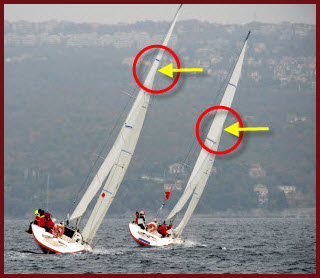
Stand near the leech of the sail and sight up the leech.
If all yarns stream in a straight line back from the leech, this means your sail has good airflow and the sail will drive the boat with power and speed. If not, go to step 3.
3. Trim from the top down
If the top telltale disappears behind the mainsail, this means you don't have enough twist at the top of the sail.
Ease the mainsheet an inch or two until the upper telltale streams.
If the two lower telltales disappear behind the mainsail, this could indicate one of two things:
- Your mainsail has too much fullness
Flatten the mainsail with the halyard and outhaul. If you have an adjustable backstay, add a bit of tension to flatten the mainsail.
- Your headsail isn't sheeted in enough
This causes the air to separate on the leeward side of the mainsail. Adjust the headsail for a proper slot so that both sails parallel one another.
Look at the photo above at the slots formed between the main and headsails on each boat. Concentrate on the lower half of the sails near the deck. The right-hand boat has better sail trim and will win this race!
~~~~~~~~~~~~~~~~~~~~
Learn how to sail a boat better than before with these three easy steps to trim your mainsail to perfection. This will boost your mainsail performance with greater power, speed, and drive.