
Will Your Sailboat Mast Clear This Dangerous 'Shock Hazard'?
Sail or motor in inland waters, and you will encounter power cables strung from one side of a narrow waterway to the other. Follow this quick guide to identify these deadly dangers at-a-glance on your nautical chart or chart plotter--wherever you choose to sail or cruise.
Know Your Corrected Overall Mast Height
You must determine the total, corrected and conservative mast height for your sailboat. Consider that a Cape Dory 27 carries a mast 38 feet above the water. If the skipper had installed a VHF whip antenna, masthead wind fly, or tri-color navigation light, that would need to be added.
Let's say 2 feet of antenna had been added to the original mast, for a total of 40 feet. As a final measure, I recommend an additional 10% or more, so add another 4 feet or so. Total mast height to clear would be 38 feet + 2 feet (antenna) = 40 feet (overall mast height) + 4 feet (10% additional safety factor) = 44 feet of clearance for safety.
Power Cable Symbols and Abbreviations
Use Chart No. 1 to learn the chart symbols and abbreviations used throughout the world. For this article, turn to Section D, Cultural Features, to see the symbols used for bridges and overhead power cables. Click Here to download a FREE copy of Chart No. 1.
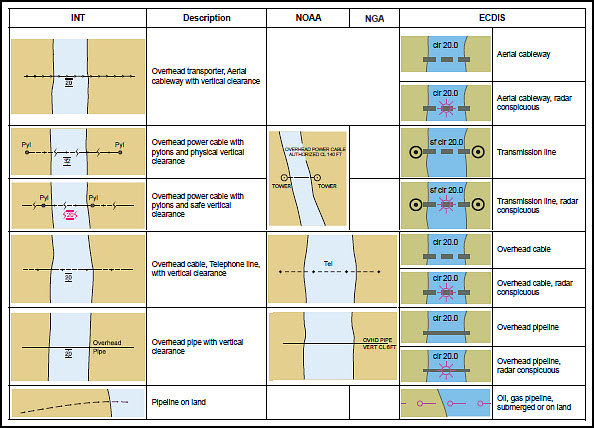
In the illustration above, towers on each side of the waterway show a dot surrounded by a circle and are abbreviated in all capital letters, which means the positions are highly accurate and the towers prominent.
The cable itself may or may not be as visible. In certain atmospheric conditions, it could be tough to see from a distance. Always check your chart near the title block for the datum used for heights. In this case, heights are given in feet above mean high water.
Other illustrations show cable strung between pylons with the vertical clearance shown in brackets. Heights are shown in feet or meters for clearances at high water. Always check your chart for the specific height units being used. To convert to feet, multiply 3 times the meters shown for a more conservative clearance. Conservative estimates add to sailing safety.
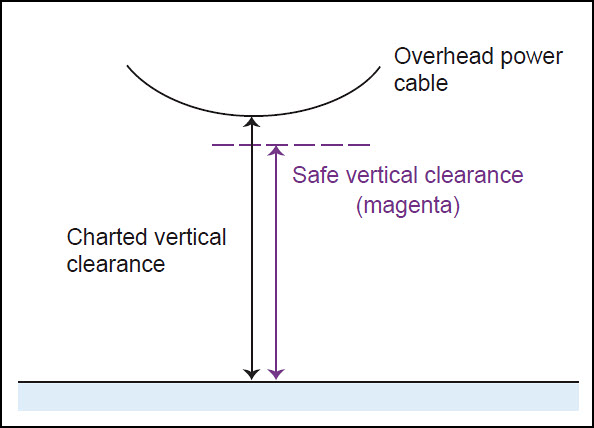
A ‘lightning bolt' or ‘starburst' in a reddish (magenta) color shows this is a power cable with live electricity flowing through. The safe vertical clearance will be shown. Note also the abbreviation ‘sf' (safe) shown on some of the electronic chart symbols on the far right column.
For example, sf clr 20.0 means the safe vertical clearance is 20.0 units of height (feet or meters, depending on the charted height datum). Use extreme caution near high-voltage power cables (more on this later). Realize that all vertical cable vertical clearances are for the center of the waterway.
Allow for Extreme Tides and ‘Jumping' Voltage
In places with extreme tides, take care to allow extra room at maximum high tide. Storm surge or heavy rainfall can add a lot to tidal height, as can spring tides--higher high tides and lower low tides than normal--twice a month at the new and full stages of the moon. If in doubt, find an alternative route to avoid a dangerous encounter that could cause costly damage or injury.
But, that's not all...
Nigel Calder, in his book ‘How to Read a Nautical Chart', warns that some power transmission lines can have extreme voltages. These cables can discharge current without direct contact. Allow an additional clearance of two to five meters (7 to 17 feet) if you see this warning on your nautical chart.
~~~~~~~~~~~~~~~~~~~~
Use these sailing navigation tips to avoid the danger of overhead power cable contact with your sailboat mast. Keep your sailing crew or partner and small sailboat safe on the inland waterways of the world--wherever in the world you choose to sail or cruise!
Captain John served as a navigator, ship driver, search and rescue coxswain, and instructor in the US Coast Guard. He drove buoy tenders and medium endurance cutters in the Gulf of Mexico, the North Atlantic, the Caribbean Sea, and the Intracoastal Waterway. He later directed the seamanship and chart navigation departments for the Professional Mariner Training Program at the Chapman School of Seamanship in Florida. He is the author of Seamanship Secrets and Captain John's Sailing Skills Series and has written seamanship articles for Blue Water Sailing and Good Old Boat magazine.