Captain John's Sailing Tips Newsletter
Don Launer's Guide to Sailboat Docking Lines
 Donald Launer has held a US Coast Guard captain's license for over 35 years and has written more than 300 magazine articles and 6 books on boating, including "Navigation Through the Ages", and "The Galley: How Things Work Plus Upgrading Ideas". For 15 years Captain Launer was Field Editor for the yearly Waterway Guide, and he is currently the Contributing Editor for Good Old Boat Magazine. He has won two Emmy Awards for his work as Technical Director of TV coverage at the Olympics.
The majority of sailboats spend more time at the dock than actively sailing. This makes the selection of dock-lines especially important. Nylon dock lines are the material of choice. The nylon dock line can be either 3-strand laid, or braided.
The advantage of braid is that it comes in attractive colors that can match your sail-covers; it rarely kinks; it is easier to coil, and it's easy on the hands.
The downside is that it tends to chafe more easily than 3-strand laid line; it is more expensive, and becomes a daunting task if the do-it-yourselfer wants to create an eye-splice (which has a higher breaking strength than a knot). For this reason most chandleries sell braided dock lines with eye-splices that have been done by professionals.
But why not use polyester (Dacron, in the US or Terylene in Great Britain) lines? The reason is that nylon lines stretch. The rule-of-thumb is that a good quality nylon line will stretch 25% of its length at 50% of its breaking strength.
This stretch provides the advantage of creating a shock-absorbing effect. This shock absorption helps prevent a dock-line from breaking, or from putting severe and sudden strains on dock or deck cleats. Although double-braided nylon line is 15% stronger than 3-strand, it stretches less, providing less shock-absorption.
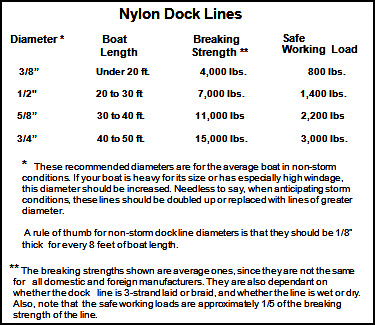
Of course, when a big blow is moving your way, large diameter lines should be installed in place of, or in addition to, your normal lines. But remember, larger diameter equals less stretch. Double the diameter and you cut the stretch to one-quarter (the stretch is inversely proportional to the square of the diameter). The advantage is that larger diameter lines are less likely to fail from chafing.
An unexpected finding by MIT after hurricane Gloria, showed that many nylon lines, which were angled across a chock, failed internally when they melted from the friction created by the repeated stretch-cycles. Most high-quality nylon lines are treated with a lubricant to reduce this type of failure- but this lubricant dissipates with the aging of the line.
Although chafing gear is a good idea whenever a dock line goes through a chock, the possibility of melting the nylon through the constant stretching cycles can be acerbated when some types of chafing gear are used, since they can trap the heat being created and prevent the cooling rain or spray from reaching this critical point. Instead, abrasion-resistant, woven polyester sleeves can be used which allow the heat to dissipate as well as letting water in to cool the line. These sleeves are available from most marine chandleries.
Another little-known quality of nylon line is that when wet it loses about 15% of its strength (which returns when the line has dried out). Since we are most concerned with strength during storm conditions - when the line is wet - this is another item to factor into the equation of storm-line size. It's also important to know that colored line has just slightly less strength than natural.
This brings us to the question of nylon line quality. There is a wide range of differences in nylon lines, with the cheaper nylon stretching more and having considerably less abrasion-resistance and internal lubrication - so don't skimp here.
It's much cheaper buying high-quality line than buying a new boat. Insurance companies estimate that up to half of the boat damage due to hurricane Andrew, that hit Florida in August 1992, could have been prevented with adequate dock lines.
Did You Miss the Latest Member's Sailing Articles?
 Download these FREE Cruising and Sailing Navigation Guides!
June 13, 2013 ~ If you are anything like me, you read all you can about new places to sail or cruise. You'll want to find the best places to anchor, facilities for engine or sail repairs, and fuel and transient slip information. But cruising guides can come at a heavy price--unless you know about one super source of information that provides you with the latest, most accurate cruising guides-all for FREE! Take advantage of this little-known goldmine of information for cruising in the US or its territories!..
//www.skippertips.com/members/1787.cfm
Do You Know Your Sailboat's Light Air "Sailability" Factor?
June 11, 2013 ~ If you want to sail with more efficiency, speed, and power you might be interested to look where few sailors ever look. Light air. Boring? Before you turn away and say that's what the auxiliary is for consider this. Veteran cruising sailors report that more than 50% of the time, you can expect to sail in winds 12 knots or less! Check your light air "sailability" with this fast, accurate formula form world cruising veteran Larry Pardey!..
//www.skippertips.com/members/1783.cfm
Three Ways to Land Your Sailboat Dinghy Alongside
June 6, 2013 ~ Imagine that you and your sailing crew have been ashore late into the evening. Now it's time to dinghy back to your anchored sailboat. Winds have increased to a fresh breeze accompanied by a chilling rain. You start the outboard--but it sputters and dies. Now you have a long row ahead of you. Good thing you brought the oars. Which approach will you use for maximum control to land your sailboat dinghy and sailing crew safe and sound alongside?..
//www.skippertips.com/members/1779.cfm
How to Choose the Perfect Sailing Crew or Partner for Cruising
June 4, 2013 ~ What makes the perfect sailing crew or sailing partner? That's a tough one. But having crewed a few times aboard big boats over the past several years, I'd like to share some thoughts with you. Use these tips for smoother sailing and cruising without the stress and hassle that incompatible crew can create..
//www.skippertips.com/members/1773.cfm
Dock a Boat Like a Pro - Use this Secret for Picture-Perfect Docking Control!
May 30, 2013 ~ One of our members sent in a great question the other day about how to control your boat speed when pivoting on a spring line. Not by engine throttle, but by wheel or tiller! Discover the secrets the pros use for "smooth as silk" boat docking you can use right now aboard your small sailboat!..
//www.skippertips.com/members/1766.cfm
Sailing Skipper's Quotable Quotes...