

Captain John's Sailing Tips Newsletter
Did you know that the correct size of docking line provides you with a triple set of super benefits? Save money, line wear, and prevent costly damage to your sailboat from line failure with this quick 'n easy guide. Enjoy this exclusive excerpt from the soon-to-be-released all new, revised 3rd edition of the highly popular eBook "Dock a Boat Like a Pro! by Captain John, coming later this month!..

How can docking line size make a difference on your small sailboat? Choose the correct line size to receive these triple benefits:
- Protect the outer core of your line from wear.
- Allow sufficient stretch to reduce loads.
- Fit beneath boat cleats for better security.
Protect the Outer Core of the Line
Expect all line to wear and chafe, even if protected with chafing gear. All lines tend to rub and stretch. Exposure to UV sunlight tends to break down outer core fibers too (except in the case of some exotic and costly high-tech rope). Larger diameter line gives you the edge to allow a bit of wear over time, without worry of failure.
Use generous amounts of chafing gear (also see "Related Articles" below) on all docking lines, no matter how long you plan on tying up. Chafing gear remains your #1 defense against catastrophic damage when docking, tying up to a mooring, or anchoring.
Allow Sufficient Stretch to Reduce Loads
Nylon line acts similar to a huge rubber band, and can stretch to 40% of its length in severe use. Take care not to select line with too large of a diameter because it might not "give" enough with lighter boats. Without enough flex, the line could act like a rigid wire to jerk your boat back and forth in boat wakes or extreme weather. This action places high loads on deck gear and could lead to failure. Take care to match line diameter to boat size and displacement to prevent damage to hull and fittings.
Fit Beneath Boat Cleat Legs for Better Security
How many times have you noticed lines that prevent a full wrap beneath the legs of a boat cleat? Many production boats come with cleats that seem to be made for small dinghies. Make sure that your boat cleats allow a complete cleat hitch with figure-eights on top for safety and security. That way, you can leave the boat unattended without the worry that your lines will fail while you are away.
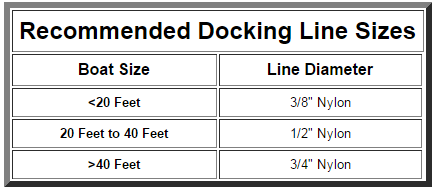
Choose a line as close to these docking line size recommendations for peace-of-mind (boat to docking line size data from Chapman Piloting, Seamanship and Small Boat Handling):
Follow these simple sailing tips on the busy waters of the world to keep you and your sailing crew safe and sound. This will provide you with worry-free sailing this sailing season--wherever in the world you choose to cruise!
Cruising with Karen Larson ~ Celebrating 15 Years!
 Karen Larson and her husband Jerry Powlas started Good Old Boat years ago and they and their dedicated staff continue to put out what I believe tops the list of 'best bang for your buck' sailing magazines available. Today, Karen tells the tale of how it all began--and has a special offer just for you!
Looking back 15 years, our naivety astounds us still. But perhaps that's what every entrepreneur says after starting a business that survived. On the other hand, if we didn't expect Good Old Boat magazine to be a success, why would we have taken the risk (and endured the long working hours) to start a sailing magazine? We can't answer that question. Dreams are made of this. Knowing now what we didn't know then, we just shake our heads and ask, "What were we thinking?" (Or should I say drinking?)
How Our Story Began...
My husband, Jerry Powlas, and I went cruising with an emphasis on brainstorming in the of fall 1997. He is the technical one, an engineer by trade. I had the publishing experience, and not a lot of that. But I had been a writer one way or the other all my life.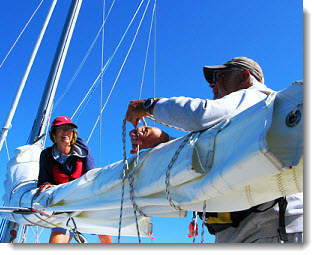 Karen and Jerry started "Good Old Boat" magazine fifteen years ago. This month, they introduce the digital, electronic version of their magazine to subscribers in PDF format.
We came home with an idea for starting a sailing magazine with a focus on the many fiberglass sailboats that no longer had official support, as their manufacturers had gone out of business long ago.
We referred to them as the "orphan fleet."We started a website in the dawning age of the Internet. It was the time of bulletin boards, AOL, and very rudimentary websites. We decided our site had to offer free resources to draw sailors to it.
The first of our resources was a comprehensive list of sailboat owners' groups, associations, and even individuals with websites focused on a type of boat. Collecting this information was a labor of love. It became the largest such list on the Internet and remains so to this day.
Although we thought we were creating a mom-and-pop magazine that we would somehow manage ourselves from the spare bedroom, Good Old Boat now has a handful of full-time employees and dozens of regular freelancers in addition to hundreds of sailors who submit articles for publication. There is no great corporate edifice somewhere. All those who work with us "commute" from a home office, choose their own hours, and communicate through email messages.
Before long we had added a couple of newsletters and a few logo T-shirts and ball caps. We produced a line of audiobooks and created PDF back issues of all our magazines and a full index of everything we've published. Because of the products and large numbers of magazine sample copies, we were suddenly in the business of shipping.
Ever the do-it-yourselfers, we managed our own subscriber database and mailed all renewal notices ourselves. We developed our website and maintained a number of servers in our basement. Just this month we put the finishing touches on a digital subscription. In keeping with that DIY philosophy, we created our own method for tracking and delivering our electronic issues (just as we had done for our printed copies). We're offering our digital subscription in a PDF format because it's the most universal for computers and mobile devices.
In spite of all the changes and additions however, we've never lost focus on the most important thing: the content of our magazine. We have never forgotten that we did not do this alone. We could not have done it without the strong loyalty and marvelous skills and experience of the staff and authors who work with us, the advertisers who like reaching good old boaters throughout the U.S. and Canada, and the readers who send their ideas, stay in touch, and keep us on track. We're creating this magazine for them, after all, and their input has given us guidance from that very first issue in June 1998.
Happy 15th birthday to each and every one!
Did You Miss the Latest Member's Sailing Articles?
 Protect Your Sailboat Engine from Corrosion Damage!
May 2, 2013 ~ If you are anything like me, it's easy to forget sailboat engine components that--like a chameleon--hide in plain site. Today, master diesel mechanic Peter Compton describes one small, hidden device that sacrifices itself to prevent corrosion in your raw-water cooling system. Follow these easy steps that could save you big $$$ in engine repair costs...
//www.skippertips.com/members/1714.cfm Dock Your Sailboat with the Magic of "Silent Signals"!
April 30, 2013 ~ Docking your small sailboat will always be a challenge, no matter the amount of wind or current. You will be surrounded by piers, pilings and boats and--of course--the dockside crowd will watch your seamanship skills. How can you make these maneuvers smoother and easier. Use these secret sailing tips from the secret files of master boat handlers to boost your docking skills sky high!..
//www.skippertips.com/members/1731.cfmAre These Vital "Keep Aboard" Lines Rigged the Right Way?
April 23, 2013 ~ Learn to sail like a pro when you rig your boat for sailing safety. Not many things fill a sailor's mind with terror like the fear of falling overboard. Sail outside of the jetties and you will want to equip your sailing crew with "stay aboard" safety techniques. Follow these easy-to-use sailing tips for safety's sake!..
//www.skippertips.com/members/1717.cfm New FREE Members eBook - "Navigation Rules Made Easy!"
April 18, 2013 ~ Howling wind, driving rain squall, or fog thicker than a bowl of New England chowder! No matter where you sail, you will want to know the top sailing tips and techniques to keep your sailing crew safe and sound in sailing challenges like these. And, you'll need to be able to "de-code" sounds, signals, lights and shapes, and take the best action to avoid catastrophe day or night on the busy waters of the world. Click the link to download Captain John's newest, member's eBook for safer sailing anywhere in the world!...
//www.skippertips.com/snip/1106.htm
Sailing Skipper's Quotable Quotes...
 Karen Larson and her husband Jerry Powlas started Good Old Boat years ago and they and their dedicated staff continue to put out what I believe tops the list of 'best bang for your buck' sailing magazines available. Today, Karen tells the tale of how it all began--and has a special offer just for you!
 Protect Your Sailboat Engine from Corrosion Damage!