Here's a sailing challenge that you can do and it's easy, requires no effort, and will reveal more about sailing seamanship than most any words. Walk down any marina dock. Look at the cleat hitches tied up aboard the boats and pier-side. Check out the coils that line the rails or lifelines. What do you notice time and again?
You can almost bet that any sailing knot will spill--or untie itself--faster unless you take five seconds to perform one critical step to enhance the knot's integrity and security. Simple, but often forgotten. Read on to discover this little-known sailing tip that you can use right now aboard your own small sailboat.
Think Through Sailing Knots in Three Steps
Consider that marine knots will often be tied with three basic steps. Each one will be critical to the next. But, unless all are in line and transition from step 1 to step 2 to step 3, your sailing knot has a big chance of failure. And that can happen when you least expect it. Think of any knot or splice like this:
Start the Knot:
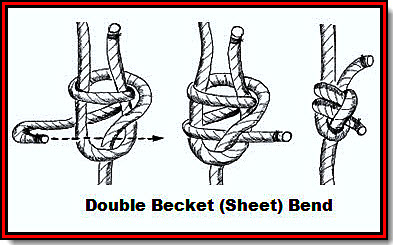
Think of the Clove Hitch. It begins with a "turn"--not a round turn, just a turn. That means you drape the line over a rail one time. That "starts" the clove hitch in the correct manner.
The Rolling Hitch starts with a "round turn" instead of the less secure turn. You start the rolling hitch with a pass of the line twice--in effect you "roll" the rolling hitch to one side (always the side of the load to start).
As you can see, these simple sailing knots require that you start them the correct way before you go to the next step...
Form the "Meat" of the Knot:
Most folks will tie the mid-part of the knot just fine once they have started the correct way. Sailing and nautical knots have form and symmetry. If you see something that just doesn't look right, it often signals you to try again.
Perhaps a tuck was taken the wrong way or the hitch was made upside down. Not to worry. I do this just as often as the next guy or gal. What matters will be to be able to recognize an error and correct it right away. That way, your sailing knot will maintain its integrity and strength without any further loss of security.
Take the Time to Finish the Knot:
Remember the opening scenario? Here's where lots of folks get in a rush. Just glad to tie the sailing knot and be done with it. Or make the coil and throw it into the sail locker? "Take five" for safety and security. Just five seconds...
That's what will be required for most any knot with a vital application aboard your boat. Work the slack out of the knot all around. Pull on each bitter end and the standing part. Turn the knot over and check the back of the knot. You want the knot as tight and compact as possible for safety and security.
And that includes sheets that join to clews of headsails or sheet bitter ends with stopper knots (or figure-eight knots) tied in the end. The weaker the knot (and both stoppers are), the more vital it will be to pull on each end of the knot and standing part to remove slack.
This will bunch up the knot turns tight next to one another. And it will help retard spillage. All knots can be made to spill--or untie themselves--after so many tugs. So take those few extra seconds to work out the slack. This small investment in time could give you a big return in sailing safety and security!
~~~~~~~~~~~~~~~~~~~~
Learn to sail like a pro when you use these sailing tips for safer and more secure sailing knots. Pass along these easy sailing tips to your sailing crew or sailing partner this sailing season--wherever in the world you choose to cruise!
Video of the Week ~ How to Pivot Your Boat Around a Pier
Imagine that you are tied up on the corner of a pier and need to back around to face the wind or current. What easy boat docking technique will make this smooth as silk? Learn this unique, little-known secret tip used by the pros. Click on the button to the left to watch this sailing skills video.
//www.skippertips.com/members/1556.cfm
John Vigor ~ Why You Should Never Trust Your Lifelines.
 Today, we feature John Vigor, sailor and veteran author of 12 boating books and scores of articles in boating magazines on three continents. John has written for Cruising World, Sail, and Good Old Boat. His career as a newspaperman spanned nearly 40 years in America, England, and South Africa. Visit John's highly entertaining blog at JohnVigor.com
LIFELINES COVERED IN WHITE PLASTIC look pretty shippy on a boat, but don't let them fool you. Few have sufficient strength to prevent a heavy crewmember crashing through and falling overboard.
The trouble is that lifelines are strung from thin vertical poles, called stanchions, that don't have much stability. Stanchions have small bases where they're attached to the deck, and the leverage applied by a falling body is tremendous.
In some cases, lifelines are too low to be effective, and serve only to catch you behind the knee and flip you overboard. If you fall from a high cabintop while the boat's heeled, you could miss the lifelines altogether.
Offshore racing authorities usually require two rows of lifelines each side with a maximum height of at least 24 inches. But 30 inches, which catches most people high on the thigh, is better if the stanchions are well anchored. They must be through-bolted, never screwed, and fitted with large and heavy backing plates underneath to spread the stress load.
Lifelines should be regarded purely as back-up protection. Primary protection comes from strong harnesses attached to substantial fittings, or jackstays, by tethers short enough to keep you on board.
Finally, be aware that white plastic coating can hide corrosion, so bare 1 x 19 stainless-steel wire is actually safer.

Deal-of-the-Week ~ Save Up to 40%* on Eclipse DSC+ VHF Radio!
Electronics on a sailboat need to be built tough to stand the ravages of salt air, sea spray, and driving rain. Standard Horizon meets this challenge with their line of VHF sea-tested products. You can now save 40% over list price on Standard Horizon's brand new hot-off-the-line Eclipse DSC+ VHF radio.
Features on this high-tech sailing electronics gear include...
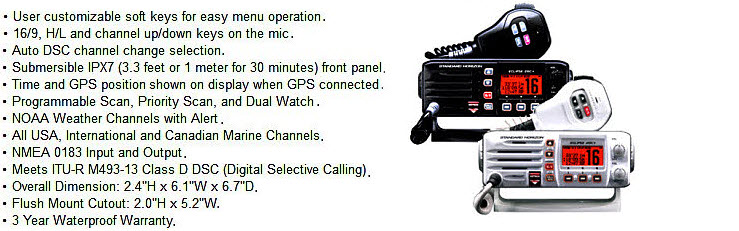
The Eclipse DSC+ is an affordable ultra compact ITU Class D VHF radio designed with a sturdy die-cast chassis making this full functioning 25 Watt radio the perfect choice for serious sailing skippers.
The microphone also features Clear Voice Noise Reduction Technology eliminating unwanted background noise like engine and wind noise during transmission ensuring clear communications. And, DSC calls can be received even when listening to other communications through a separate DSC receiver.
If you are anything like me, I want a great return policy. Horizon states that if your Eclipse DSC+ ever fails for any reason including water damage during normal use in the first three years, they'll repair or replace it free--without hassle or charges! Now, that's one super sailor's deal that will be hard to beat anywhere on the planet!
Standard Horizon Eclipse DSC+ VHF Radio Deal Details:
Deal Specs: Save up to 40%*; plus a $20 mail-in rebate**.
Deal Dates: See notes below.
Order Online: Defender Discount Offer
Order by Phone: 800-628-8225
* Savings and discounts described above are in effect at the time of this newsletter issue.
Savings and discounts are subject to change by the vendor and may change at any time.
Contact the vendor for price or discount changes prior to making a purchase decision.
** Additional $20 mail-in rebate available from Standard Horizon for
US or Canadian customers who purchase this item before July 31, 2013.
Did You Miss the Latest Member's Sailing Articles?
 Are These Vital "Keep Aboard" Lines Rigged the Right Way?
April 23, 2013 ~ Learn to sail like a pro when you rig your boat for sailing safety. Not many things fill a sailor's mind with terror like the fear of falling overboard. Sail outside of the jetties and you will want to equip your sailing crew with "stay aboard" safety techniques. Follow these easy-to-use sailing tips for safety's sake!..
//www.skippertips.com/members/1717.cfm
New FREE Members eBook - "Navigation Rules Made Easy!"
April 18, 2013 ~ Howling wind, driving rain squall, or fog thicker than a bowl of New England chowder! No matter where you sail, you will want to know the top sailing tips and techniques to keep your sailing crew safe and sound in sailing challenges like these. And, you'll need to be able to "de-code" sounds, signals, lights and shapes, and take the best action to avoid catastrophe day or night on the busy waters of the world. Click the link to download Captain John's newest, member's eBook for safer sailing anywhere in the world!...
//www.skippertips.com/snip/1106.htm
Sailing Navigation - How to Sail Down a GPS "Lat-Long Line"
April 16, 2013 ~ Rocky shoals to the right. Coral heads to the left. And your destination lies six miles on the other side of this "ship killing" pass. How can you take your small cruising sailboat through with calm confidence and navigational know-how? Use your GPS as a backup navigation method along with careful coastal chart plotting. Read this excerpt from the eBook "Coastal Navigation Quick-Tips" to discover one of the niftiest navigation techniques in all of sailing...
//www.skippertips.com/members/1705.cfm
Money Saving Sailing Tips - The #1 Secret to Mainsail Reefing!
April 11, 2013 ~ Pop-Pop-Pop!!! We heard them before we saw them. Broken sail slugs popping like firecrackers. And then we saw what no sailor wants to see--the sail seam ripped from luff to leech. The mainsail, now shredded and torn, clung to our mast and boom by slivers of sail cloth, as we flew down the narrow channel in gusty "near-gale force" winds. Use this fast, easy sailing solution to protect your expensive mainsail from a similar fate...
//www.skippertips.com/members/1702.cfm
Sailing Skipper's Quotable Quotes...