Imagine that you are sailing offshore and approach your landfall from about 8 nautical miles--in pea soup fog. You have your sailing course set to the large sea buoy that marks the harbor entrance. But the sailing directions warn not to place too much trust in GPS. Several sailboats have piled up on the dangerous reefs on the approach. What now, skipper?
Aim for a specific buoy or landmark and if you are off by just a few degrees--or your GPS waypoint has an unknown error--you could "miss the mark". And if you do, which way would you turn?
Use the "offset landfall" navigation technique. You will aim on purpose to one side or the other of the mark. Use this sailing solution to find your way to a buoy or channel entrance in low visibility or any other time you are in doubt of your position. Follow these five simple steps for safer sailing to backup your electronic black-boxes.
1. Study the Chart for a Prominent Depth Curve
Use the largest scale chart available for navigation. The smallest practical chart scale for this navigation technique will be about 1:100,000 (1:80,000 if possible). Coastal approach charts on these scales provide adequate detail for approach and entrance to major waterways (shift to a larger scale once you enter the waterway--see note below).
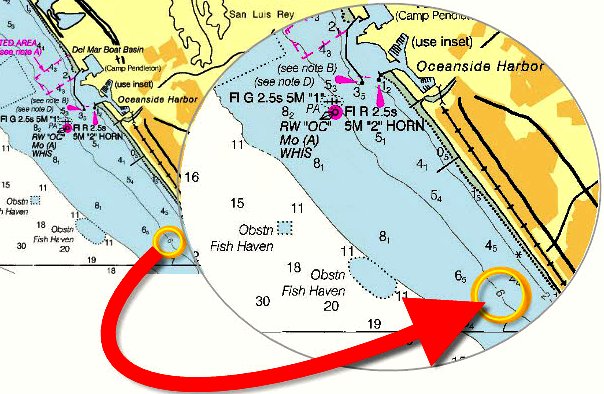
Look for curved, wavy lines--called "depth curves" or "depth contours"--that somewhat parallel the shore line. Scan along the depth curve to find a small number inserted somewhere along the line (see illustration above). That tells you the depth all along the contour curve (check your chart datum to determine whether depths are shown in feet, fathoms or meters).
Note: Use the largest scale available for safe sailing navigation. In sheltered waters just inside the coast, use 1:60,000, 1:40,000, 1:20,000, 1:10,000 or larger scales for navigation near shoal water.
2. Scan for Wrecks, Rocks, or Obstructions.
Scan up and down the depth curve and the possible approach routes to the depth curve to the right or left of the objective. Here you will not consider wind or current direction. Much more important will be a clear path on the approach to the contour curve and a clear path as you follow the contour curve to the objective.
Note in in the illustration, we have decided to aim to the right of our objective--buoy "OC". We have scanned all along the depth curve to make sure that no shoals, wrecks or obstructions lie along the depth curve. There are two small fish havens (to the west) and a dangerous rock just inside the 2 fathom curve (to the east).
But these dangers lie well off the depth curve. As long as we stay along the depth curve, we should have a clear run to buoy "OC". Put safety of sailing crew and sailboat first for sailing safety in all cases.
3. Determine an Offset Amount.
How far should you aim to the right or left? Use a more generous offset in isolated areas like a flat run of beach with few marks to confirm your navigation. This may be one to two miles. Increase the distance in thick weather (fog, heavy weather).
4. Stay Upwind to "Run Down the Curve".
Sail upwind or up current if practicable and safe to do so. That way, when your depth sounder indicates arrival at the depth curve, you can turn downwind. Or, in the case of current that flows parallel to the land profile, aim up current and then you can turn and have a fair current and faster, easier passage to your objective.
5. Put Your Navigation Technique to Work.
Use the basics of good sailing navigation--a dead reckoning course labeled and plotted to your offset aim point. Estimate the approximate time of expected arrival at the depth curve. When you have run out your time, slow down and proceed with caution. If in doubt--head back out offshore.
Once your depth sounder indicates you are at the depth curve, turn and run down wind or down current (if this was a practical choice) to your destination. Again, estimate your new speed and revised time of arrival at your objective. Watch the depth sounder to help maintain the proper distance offshore.
~~~~~~~~~~~~~~~~~~~~
Captain John's Sailing Tip
Follow any depth curve at the slowest speed possible for a more accurate readout form your depth sounder. Post a lookout to scan for vessels, dangers, or other navigation marks ahead or ashore to verify your position.
~~~~~~~~~~~~~~~~~~~~
Practice this easy and fun sailing navigation technique in clear sailing weather so that you will be prepared for the future. Sail safe on the waters of the world this sailing season--wherever you choose to sail or cruise!
Cruising with Karen Larson ~ This is Why We Sail!
 Karen Larson and her husband Jerry Powlas started Good Old Boat years ago and they and their dedicated staff continue to put out what I believe tops the list of 'best bang for your buck' sailing magazines available. Today, Karen shows you how you can make your cruising dreams a reality. Pick up your copy of "Good Old Boat" magazine at Barnes & Noble or visit their website at Good Old Boat Magazine
Sometimes a camera simply can't capture a scene. The late morning sun has cast a river of diamonds between our boat and the shore. The shore is a series of long stretches of wooded hillsides backed by what we call "mountains" here in the Midwest. These increasing elevations blend from deep forest green in front to a hazy pale blue at the most distant level. This color morph phenomenon is a common scene but one I love dearly.
There is nothing at all on the water from the shore to the far horizon. We have seen only one fishing boat and one sailboat all day.
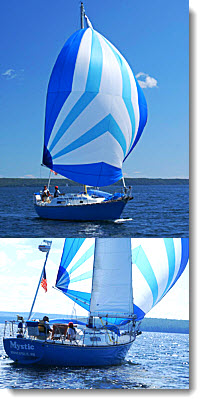
We're flying our new spinnaker in very light air as we head 30-some miles northwest toward the next port on the northern coast of Michigan's Upper Peninsula. I figure that, with our lovely spinnaker, we must surely look like the most beautiful girl at the dance.
But there's no one here to appreciate our colorful sail. Like the up-sun photo of the hillside, a photo of our spinnaker is another photo that I can't capture, since I'm aboard the boat. Some photos must be stored in one's memory bank instead.
The forests shelter a few cabins along the shoreline, but if anyone's home it's unlikely that they have run to the window to look out in awe upon our lovely sailing vision a mile or so offshore. Instead, I wax rhapsodic over the view of the shoreline and on the feeling of complete contentment that prevails aboard.
We have everything we need here on our cruising island. We are well fed, well rested, and absolutely comfortable in every way. We haven't followed the news in more than a week. There's just enough breeze to keep us from being fried out here on this downwind sail. And for once on Lake Superior, we're not freezing.
We are completely at peace, absolutely content, and totally relaxed. This is why we sail.
Sailing Video - Are You Ready for a Flooding Emergency?
If you hit a submerged object, you could punch a hole in your hull and water could flood in at an astronomical rate! What onboard tools could you use in this sailing emergency
to slow the intrusion of water into your boat? Gather these materials now to be prepared for the unexpected! Watch this exclusive sailing skills video to learn more.
//www.skippertips.com/members/1853.cfm
Deal-of-the-Week ~ Save Up to 20%* on Forespar Whisker Pole
Make sailing downwind fast, easy and more fun when you maximize exposed sail area with a whisker pole. And you'll want a pole that can handle the loads of a big Genoa. You can use this pole on sailboats up to about 30 feet long.
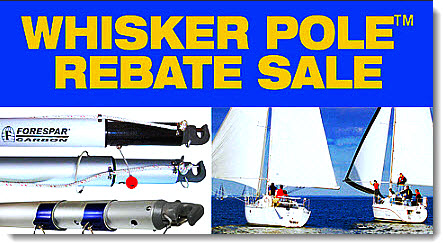
Save 20% off of list price (plus a mail in Rebate**) on Forespar's latest anodized aluminum Heavy Duty Twist Lock Whisker Pole. Features include...
Forespar Heavy Duty Whisker Pole Deal Details:
Deal Specs: Save up to 20%*; plus a $15 mail-in cash rebate**.
Deal Dates: See notes below.
Order Online: Defender Discount Offer
Order by Phone: 800-628-8225
* Savings and discounts described above are in effect at the time of this newsletter issue.
Savings and discounts are subject to change by the vendor and may change at any time.
Contact the vendor for price or discount changes prior to making a purchase decision.
** Additional $15 mail-in rebate from Forespar for North American customers.
Purchase by May 31, 2013. Mail-in rebate form must be postmarked within 7 days of purchase.
See Rebate Form for complete details and requirements.
Did You Miss the Latest Member's Sailing Articles?
 How We Saved $100,000 on Our Sailboat! - Special Member Article
March 28, 2013 ~ Costs of sailing gear and systems continues to rise. So sailors everywhere are in a scramble to save money with the "fitting out" season upon us. And long time SkipperTips members Bill and Jo Bowman have some sage advice that could save you some serious money for sailing. And you'll be amazed at just how easy it can be. Read on to discover how a single piece of sailing gear they just happened upon saved them the possible purchase of a new cruising sailboat in today's exclusive member sailing article!..
//www.skippertips.com/members/1682.cfm
Boat Anchoring Secrets - Are You Dragging? Five Ways to Check!
March 26, 2013 ~ Lower and set your anchor and that's just one small step in the total process of safe 'n sound anchoring. Check your position fast and easy to make sure your small sailboat stays put. Follow these five sailing navigation safety tips in this first of a two-part series on techniques and strategies to use after you anchor your sailboat...
//www.skippertips.com/members/1667.cfm
Protect Your Costly Sailboat with These "Silent Sentries"!
March 21, 2013 ~ What sailing gear could protect your hull inside a slip, alongside a pier or wharf, if you lost an engine inside a marina, when nested alongside another boat? What if you happen to tie up your small sailboat to a pier or inside a slip in an area with a lot of tidal rise and fall, boat wakes, ground swell, storm surge?..
//www.skippertips.com/members/1676.cfm
Sailing Delivery to Miami - Special Member Feature Article!
March 19, 2013 ~ Today, SkipperTips member Michael Conlon shares his latest sailing adventure with us. Mike helped deliver a beautiful, brand new Brevarian Vision 46 from Annapolis, Maryland to the Miami, Florida Boat Show earlier this year. Read on to discover what Mike learned on this delivery sailing in inland waterways and offshore...
//www.skippertips.com/members/1672.cfm
Find This "Sailing Landfall" Solution in Sixty Seconds!
March 14, 2013 ~ You are sailing toward landfall, and your nautical GPS and plotter have been unreliable. Matter of fact, power has pulsed off and on for three days now. You need to fall back to a reliable sailing navigation technique that will give you a good, solid estimate of when you can expect to sight the lighthouse just over the horizon. Here's one simple sailing calculation you can make in less than sixty seconds. Follow these easy sailing tips for safer sailing worldwide!..
//www.skippertips.com/members/1664.cfm
Sailing Skipper's Quotable Quotes...