Have you ever seen a coastal or offshore tug while out sailing? Did you realize that they could be towing astern--and the towline could be invisible? Learn the vital steps you need to take to avoid serious injury or damage to your sailboat. Follow these three easy sailing navigation steps along with the illustration to stay safe on the waters of the world.

Sail in inland, coastal or offshore waters, and you will encounter tugs and their tows. What you see may or may not tell the entire story. For example, you will see the tugboat first. But is he or she towing or not?
How can you determine whether --in accordance with the Navigation Rules--the vessel you see will be considered just another power driven vessel or a vessel engaged in towing. Why is this of vital importance to the sailing skipper?
I believe first and foremost -- "trust but verify". The tug skipper and crew might have forgotten to display the proper day shapes or (at night or in periods of reduced visibility) special lights required for a vessel engaged in towing (find out more about day shapes and lights in the upcoming new Member's eBook--see below).
Which is one of the primary reasons that I believe one of the most important navigation tools for safety will be a binocular. I would not think of going onto the water without them. And they need not be the most expensive on the block. My current binocular cost less than $125 on sale (West Marine) and has provided superb service in a variety of conditions. Look for the phrase 'nitrogen charged' in the specs. This indicates a waterproof--not just water resistant--binocular.
Why You Might Not See a Tugs Towline!
Consider that vessels engaged in towing have tow lines and gear that stretch from the stern of the tug to the bow of the boat, barge, or ship astern. And you may or may not see all of the tow line. Commercial towing hawser (tow line) can consist of large diameter wire rope that runs from stern (of the tug) to bow (of the vessel being towed).
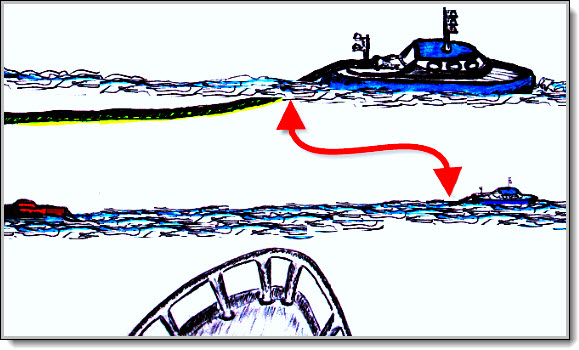
Tug skippers adjust course and speed to keep their tow "in step". That means when the tug goes up on a wave, the tow needs to do the same. When the tug goes down the face of a wave, the tow needs to do the same. Otherwise, the shock load on the tow line could cause it to snap! So how do they achieve this?
Part of the art requires that the tow line has enough slack (called "catenary"). This keeps a slight "U" shape in the tow line. The objective will often be to keep that tow line just at or below the surface of the water. And therein lies the dilemma for other boaters.
You may or may not see the tow line. What now, skipper? Take these three vital steps anytime you sight a tug and are unable to see the entire length of tow line that runs from her stern to the bow of the vessel being towed.
*Note:
We are not talking about "Sea Tow" vessels. For the most part, those are small boats that use short tow lines astern that will be visible most all of the time. Once inside sheltered waters, they will "make up" the tow alongside (tow-on-the-hip). Here, we will discuss large commercial tugs with full crews and complex towing gear.
Three Steps to Avoid Tow Line Entanglement
1. Use a binocular to scan behind the tug. Tows can be 1/2 mile or more aft of the tug stern.
2. At night, look for two or three white lights in a vertical line on the tug's mast. These indicate how far the tow lies behind the tug (2 white lights = less than 200 meters; 3 white lights = greater than 200 meters).
By day, tugs with a tow greater than 200 meters astern carry a black diamond shape high up in the rigging. The tow should also show this shape.
3. Avoid the temptation to pass astern of the tug. Stop or heave to until you see the vessel being towed and it passes your position. Vessels or barges being towed carry the same lighting as a sailboat--side lights (green to starboard, red to port) and a stern light (white). They can be tough to spot in a seaway. Proceed after you have made positive identification and both vessels have passed by you.
~~~~~~~~~~~~~~~~~~~~~
Learn those vital sailing safety tips to sail safer on the busy waters of the world. Keep your small sailboat and sailing crew clear of commercial tugs and tows for sailing safety--wherever in the world your choose to sail or cruise!
Excerpt from the soon-to-be-released Member's eBook Navigation Rules Made Easy by Captain John.
Discover the most vital "need to know NavRules" in this collection of tips tailored for short-handed sailors.
Cruising Tips ~ Connie McBride on Marking Your Anchor Chain
 Connie McBride, her husband Dave, and their three young boys sailed away from the dock in 2002 in their 34' Creekmore Eurisko. Together they explored the Caribbean as the boys grew up and moved out one by one. After becoming empty nesters, Dave and Connie downsized and changed their cruising by buying a Bolger sharpie AS-29 to explore the shallow waters closer to home, their children and new grandson.
Today, Connie shows you how she and Dave mark their anchor chain. Be sure to visit Connie's site at www.simplysailingonline.com. Find all of Connie's cruising books on Amazon and Create Space, including her new book available on Kindle "Tips, Tricks and Tales: The Best of Simply Sailing Online"

When the wind starts to howl and we are in an unknown anchorage with questionable holding, having adequate scope can make the difference between worrying (and possibly dragging) all night and getting a good night's sleep. Knowing we have enough anchor chain overboard to keep us safe is as important to our well-being as actually having enough.
Since we have 300 feet of chain on our primary anchor (currently a 44 pound Bruce) and a manual windlass, it is nearly impossible to guess how much chain has followed the anchor overboard.
I am a horrible estimator, and over the years Dave has tired of "I don't know" as an answer to the "How much did you let out?" question. Before we left to go cruising we had read about the following unique system for marking anchor rode. We adopted it and are so pleased that I would like to share it.
I have seen orange plastic chain markers for sale, but in the rain and dark it would be almost impossible to see the numbers. Once they get covered in mud after sitting on the bottom for weeks they will be equally worthless even during the day. I have known several cruisers who spray paint marks on their chain. These too are difficult to find as they zoom past on their way out the hawse pipe and much like the plastic markers, they are invisible when covered in sand or mud.
What we needed was something easily visible even in the dark when caked with leftovers from the bottom. We decided on ½" tubular polyester webbing sewn through the links of chain. They run freely through the windlass, and we can count them by feel if necessary. We chose polyester instead of nylon because it is stronger and more UV resistant.
Since we end-for-end our rode after a few years, we wanted a system for counting that could be used starting at either end. Every 30 feet (5 fathoms) we sewed a piece of webbing, choosing white for increased visibility. Thirty feet from either end is one piece of webbing, at 60 feet (10 fathoms) there are two, etc. until they meet at the middle.
I am more likely to miscount five pieces than not know that I am nearing neither end, so we use one piece again at the middle rather than five. Therefore, from either end the rode is marked with 1-2-3-4-1-4-3-2-1 pieces of webbing. Though it may seem like a hassle to multiply by 30, we now have a sense of how much each mark is and rarely have to convert it to feet. We never use less than three marks (90 feet), and that would only be enough when tucked up in a small creek off the Chesapeake Bay for the afternoon.
Shallow anchorages with a sandy bottom in the Caribbean we will occasionally hang from 4 marks (120 feet), but sleep better at the second 4 (180 feet). In deep water anchorages in the Caribbean, the second 2 (240 feet) is not uncommon, but only once in our first eight years have we used the final 1 (270 feet) and wished we had more.
After 4 years we switched the chain end-for-end then after 8 years we replaced the chain completely. When we inspected the old polyester webbing markers they were still as good as new. On the new chain we sewed new webbing marks the same way and hope to enjoy 8 more years of not having lay awake and wonder if we have let out adequate scope.
Video-of-the-Week ~ Sailing to the Top of a Mountain.
This week, I came across a remarkable video about a 17 year old sailor. She has overcome enormous obstacles to achieve her goals of sailing over 400 miles along the coast in a tiny sailboat and climbing to the peak of a mountain over 2,900 above sea level. Crank up your speakers, sit back and enjoy the video.
//www.skippertips.com/public/2337.cfm
Deal-of-the-Week ~ Save Up to 40%* on Eclipse DSC+ VHF Radio!
Electronics on a sailboat need to be built tough to stand the ravages of salt air, sea spray, and driving rain. Standard Horizon meets this challenge with their line of VHF sea-tested products. You can now save up to 40% over list price on Standard Horizon's brand new hot-off-the-line Eclipse DSC+ VHF radio.
Features on this high-tech sailing electronics gear include...
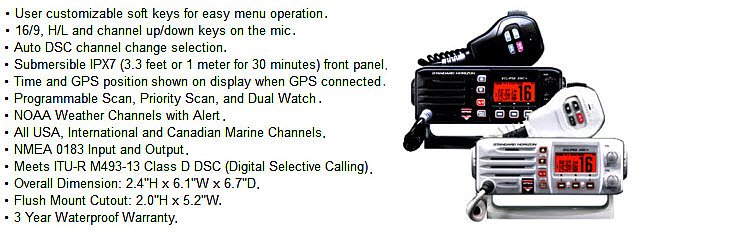
The Eclipse DSC+ is an affordable ultra compact ITU Class D VHF radio designed with a sturdy die-cast chassis making this full functioning 25 Watt radio the perfect choice for serious sailing skippers.
The microphone also features Clear Voice Noise Reduction Technology eliminating unwanted background noise like engine and wind noise during transmission ensuring clear communications. And, DSC calls can be received even when listening to other communications through a separate DSC receiver.
If you are anything like me, I want a great return policy. Horizon states that if your Eclipse DSC+ ever fails for any reason including water damage during normal use in the first three years, they'll repair or replace it free--without hassle or charges! Now, that's one super sailor's deal that will be hard to beat anywhere on the planet!
Standard Horizon Eclipse DSC+ VHF Radio Deal Details:
Deal Specs: Save up to 40%*; plus a $20 mail-in rebate**.
Deal Dates: See notes below.
Order Online: Defender Discount Offer
Order by Phone: 800-628-8225
* Savings and discounts described above are in effect at the time of this newsletter issue.
Savings and discounts are subject to change by the vendor and may change at any time.
Contact the vendor for price or discount changes prior to making a purchase decision.
** Additional $20 mail-in rebate from Standard Horizon for US or Canadian customers.
Mail-in rebate form must be postmarked by August 15, 2013.
Did You Miss the Latest Member's Sailing Articles?
 What is "Heavy Weather Sailing" Aboard Your Sailboat?
March 7, 2013 ~ You've planned your coastal sailing cruise with care, but expect things to get a big bumpy overnight. Just what does the term "heavy weather" really mean--to your specific sailboat and her short-handed crew? Get prepared ahead of time this sailing season. Put these five sailing tips into play aboard your sailboat for safer sailing in tough weather! ..
//www.skippertips.com/members/1637.cfm
Five Sailing Tips to Prevent Deadly Sailboat Fires
March 5, 2013 ~ Sailing season starts in just a few weeks, so it's a good idea to begin preparations now. Like your "must check these things aboard" list for fire prevention. Sure, sailing rigging, ground tackle, and engines need their own individual inspections. But your #1 threat to sailing crew safety will be enemy #1--fire. Start this season with these five sailing safety tips..
//www.skippertips.com/members/1648.cfm
Five Sailing Rigging Secrets to Save You Money!
February 28, 2013 ~ If you want to learn to sail like a pro, you need to know how to keep your sailing rope in prime "fighting" shape. You see, every time you go sailing, those costly halyards, sheets, anchor rope rodes, and extra line in those sail-lockers goes into battle. What five easy steps can you take right now to save money, extend line life, and keep your running rigging strong and supple all sailing season long?..
//www.skippertips.com/members/1643.cfm
Heavy Weather Sailing - Five Tips to Choose and Use a Storm Jib
February 26, 2013 ~ Remember that storm jib you bought with the boat? When was the last time you hanked it, hoisted it, and tested it? Many sailors never have, and this highly specialized boat sail gets left in a sail bag--until extreme conditions call for an exit strategy. But if you don't know what it takes to rig it, you will be in a world of hurt when you need it the most. Make sure you go through a drill with your sailing crew with this champion of heavy weather sailing.
//www.skippertips.com/members/1638.cfm
Know Your "Navigational Draft" for Sailing Safety
February 22, 2013 ~ I believe a big part of sailing navigation involves the challenge to keep enough water beneath your keel at all stages of the tide. But that can be a whole lot tougher than it sounds. Decide when to use the little-known sailing secret of "navigational draft" aboard your own small sailboat--wherever you choose to sail or cruise!..
//www.skippertips.com/members/1629.cfm
Sailing Skipper's Quotable Quotes...