

If you are going cruising or racing, space will be at a premium. "Shrink wrapped" sails take up much less room. Have you labeled your sail corners to make your sailing crews life easier. Do you have each sail's measurements ready to hand to any sailmaker in case emergency repairs are needed?

Learn to sail like a pro with these five fast sailing tips from secret files of offshore pro sailors. They will keep your sails organized, ready to use in an instant, and easier to use in any marine weather, from screaming squall to howling gale!
1. Shrink-wrap Your Sails to Save Space
Do you carry a spare mainsail, Genoa or other large area sail? They take up lots of room in a standard size sail bag. Veteran delivery skipper Bill Seifert got this idea from a life raft re-packer.
Buy a super-size plastic bag. Fold your sail and slide it inside. Use a vacuum pump to suck the air out. This shrinks a large mainsail down to less than 18" square and keeps moisture out too. If you do not have a vacuum pump, zip the bag about 2/3 of the way across. Push as much air out as possible with hands and knees. Zip the bag up the rest of the way when done.
2. Label Sail Corners for Easy Identification
Make it super simple to know just what sail corner you see when you un-bag a sail. Not all sails are bagged the right way. I always learned to slide a folded sail into a sailbag so that the top corner was the first to be attached.
On any headsail (i.e. working jib, Genoa, lapper, storm jib) this was the tack. On a mainsail, this was the clew. But it makes good sense to mark these corners so that they can be identified at-a-glance day or night, and in weather fair or foul.
Use a permanent ink marker to identify each corner of all of your headsails. Why permanent ink? The forward corners of your sails will be exposed to spray, sea and salt air and dirt. Pencil could wear off over time. In the end, you must decide, but I believe a laundry type permanent ink pen provides the best solution.
Label the type of headsail (150% Genoa, Storm Jib) at the head and tack. Some sailors recommend that you draw small arrows that point at each jib-snap on hank-on type headsails. This makes foredeck work easier when sail reefing or changing our headsails.
3. Save Time With a Boat Parameter Record
If you sail, you can bet on an eventual visit to a sailmaker for new sails, sail repairs, sail modifications, or hardware installation. Save lots of time when you provide your sailmaker with your specific sailboat's "sail plan parameters". It's fun and easy to do. And, once you determine this, you can keep it in your boat log as a permanent record for future use. Follow these easy tips:
Set up a graph with four columns labeled "Sail", "Luff", "Leech (LP)", and "Foot". Measure the mainsail first: luff, leech, and foot. To measure the leech, hold one end of the tape at the clew and pull it straight to the head. Ignore the excess cloth--called "roach"--outside of the straight line.
On each headsail, measure the luff and foot first. Then measure the longest distance to the luff (called the luff-perpendicular, or LP). Hold the tape at the clew, pull the tape out to the luff, and swing an arc to the farthest point on the luff. Write the distance under the "leech (LP)" column.
You might also have a copy of your boats I, J, P, and E parameters. I and J measure the total sail area available for sails set forward of the mast. P and E measure the total sail area available for sails set onto the mast. You can find these measurements on sail plans or boat drawings. Or, contact Sailrite and ask if they have a copy of these four parameters on file.
4. Use "Circle-Numbers" for Luff Reef Locations
There's a squall howling at 2AM one morning. You go forward to lower the mainsail to the second luff reef cringle. The cockpit crew releases the halyard and the sail shoots down the mast slot. You see two cringles in the sail folds--but which do you choose?
If you are anything like me, this happens more often than it should. Put guesswork to bed with a simple, temporary marking method you can use before you cast off that first line.
Use a pencil to draw a big 1 inside a circle on both sides of the first luff reef cringle patches. Draw a 2 inside a circle on both sides of the second luff reef cringle patches. If you have a third reef grommet, add a circled "3" for that one. Now you know beyond a doubt which reef to set in any marine weather--day or night.
5. Contain the Flaked Mainsail Fast
Wrapping sail ties around a flaked mainsail in bumpy seas can be like riding one of those crazy bulls in a Texas bar. Then you have to pick the longest ties for the bulkier forward part of the mainsail. Instead, use one long continuous line. Every 18" to 24", tie a light piece of line onto the long continuous line with a rolling hitch or lark's head knot.
Follow these simple, fast steps:
- Attach your long continuous line to a hole or other fitting at the end of the boom.
- Flake the mainsail atop the boom.
- Pull the long continuous line taut and tie it off to a fitting at the mast close to the top of the boom.
- Tie off the bunt of the mainsail with your staggered ties.
You might ask "Why not use bungee chord instead of short lengths of line?". After all, some similar off-the-shelf sail containment systems use bungee. But if you let go of a stretched piece of bungee cord, you could get a surprise "bee sting" in the face or worse--the eye! You decide, but line will be safer and more seamanlike aboard any boat!
~~~~~~~~~~~~~~~~~~~~
Put these learn to sail super tips from pro cruising and racing sailors in play today. Prepare your small cruising or racing sailboat sails ahead of time to save you and your sailing crew time and frustration in the future.
Don Launer Reveals the Mystery Behind Your GPS
 Donald Launer has held a US Coast Guard captain's license for over 35 years and has written more than 300 magazine articles and 6 books on boating, including "Navigation Through the Ages", and "The Galley: How Things Work Plus Upgrading Ideas". For 15 years Captain Launer was Field Editor for the yearly Waterway Guide, and he is currently the Contributing Editor for Good Old Boat Magazine. He has won two Emmy Awards for his work as Technical Director of TV coverage at the Olympics.In October 1957, the first man-made satellite was thrust into orbit around the earth. The USSR's tiny Sputnik had beaten the United States into space. The US, in an effort to learn as much about Sputnik as possible, monitored the beeping signal it transmitted, and was able to determine its location through the Doppler affect.
This was the genesis of using man-made satellites to determine navigational information. But it wasn't till the 1970s when the satellite navigation system, as we now know it, began to take shape.
The Global Positioning System (GPS) is a satellite navigation system that was designed for and is operated by the US military, but it is now used by millions of civilians world-wide.
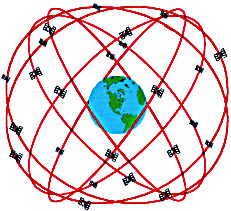
The basic space segment of this system, known as the "GPS Operational Constellation," consists of 24 satellites that orbit the earth twice a day, however there are often more than 24 in space, as new ones are placed in orbit to replace those whose on-board fuel has become nearly exhausted.
This GPS constellation provides the user at any point on earth with five or more visible satellites at any time. With access to just three satellites, a two-dimensional fix (Lat. & Lon.) can be determined. And with four satellites, GPS receivers can compute a location in three dimensions. This makes the GPS navigation system ideal for aircraft, as well as for boats, ground transportation, and hikers.
Each GPS satellite contains an atomic clock, and by measuring the time interval between the transmission and reception of a satellite signal, a spherical "line-of-position" is created around each satellite. The intersection of these spherical lines-of-position determine your location.
The GPS satellites transmit in the microwave spectrum. At these frequencies the wavelength is very short and the receiving antenna can consequently be very small. One of the problems with this frequency is that it does not easily pass through things like house roofs, cabin tops, or people (if you're holding a hand-held GPS at waist-height, the receiver has difficulty acquiring a satellite from the other side of your body).
As improvements continue, consumer prices for GPS receivers keep dropping, while accuracy, operational simplicity, and extra features are expanding. GPS receivers have the ability to "talk" to other electronic equipment on board, such as an electronic chart-plotter, autopilot, VHF-FM radio, radar, etc.
But in order to carry on their conversation, they must be talking the same NMEA protocol. Newer units, that combine a GPS and chart-plotter, as well as radar and a fish-finder, have a very small battery drain, and provide today's sailor with navigational capabilities undreamed of a few decades ago.
Video of the Week ~ Sail Trim Secrets for Genoa Power
Did you know that sail trim for your Genoa should start from a neutral block position? Find this magic spot and you will be able to make make your Genoa more powerful in those super light morning winds or in gusty afternoon breezes.Watch this exclusive sailing skills video now to find out more! //www.skippertips.com/public/1588.cfm
Deal-of-the-Week ~ Save Up to 40%* on Eclipse DSC+ VHF Radio!
Electronics on a sailboat need to be built tough to stand the ravages of salt air, sea spray, and driving rain. Standard Horizon meets this challenge with their line of VHF sea-tested products. You can now save up to 40% over list price on Standard Horizon's brand new hot-off-the-line Eclipse DSC+ VHF radio.
Features on this high-tech sailing electronics gear include...
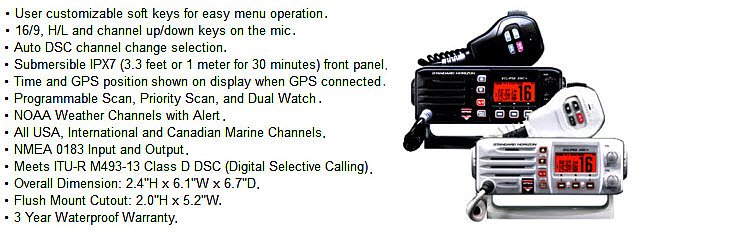
The Eclipse DSC+ is an affordable ultra compact ITU Class D VHF radio designed with a sturdy die-cast chassis making this full functioning 25 Watt radio the perfect choice for serious sailing skippers.
The microphone also features Clear Voice Noise Reduction Technology eliminating unwanted background noise like engine and wind noise during transmission ensuring clear communications. And, DSC calls can be received even when listening to other communications through a separate DSC receiver.
If you are anything like me, I want a great return policy. Horizon states that if your Eclipse DSC+ ever fails for any reason including water damage during normal use in the first three years, they'll repair or replace it free--without hassle or charges! Now, that's one super sailor's deal that will be hard to beat anywhere on the planet!
Standard Horizon Eclipse DSC+ VHF Radio Deal Details:
Deal Specs: Save up to 40%*; plus a $20 mail-in rebate**.
Deal Dates: See notes below.
Order Online: Defender Discount Offer
Order by Phone: 800-628-8225* Savings and discounts described above are in effect at the time of this newsletter issue.
Savings and discounts are subject to change by the vendor and may change at any time.
Contact the vendor for price or discount changes prior to making a purchase decision.** Additional $20 mail-in rebate from Standard Horizon for US or Canadian customers.
Mail-in rebate form must be postmarked by August 15, 2013.
Did You Miss the Latest Member's Sailing Articles?
 Five Sailing Rigging Secrets to Save You Money!
February 28, 2013 ~ If you want to learn to sail like a pro, you need to know how to keep your sailing rope in prime "fighting" shape. You see, every time you go sailing, those costly halyards, sheets, anchor rope rodes, and extra line in those sail-lockers goes into battle. What five easy steps can you take right now to save money, extend line life, and keep your running rigging strong and supple all sailing season long?..
//www.skippertips.com/members/1643.cfm Heavy Weather Sailing - Five Tips to Choose and Use a Storm Jib
February 26, 2013 ~ Remember that storm jib you bought with the boat? When was the last time you hanked it, hoisted it, and tested it? Many sailors never have, and this highly specialized boat sail gets left in a sail bag--until extreme conditions call for an exit strategy. But if you don't know what it takes to rig it, you will be in a world of hurt when you need it the most. Make sure you go through a drill with your sailing crew with this champion of heavy weather sailing.
//www.skippertips.com/members/1638.cfm Know Your "Navigational Draft" for Sailing Safety
February 22, 2013 ~ I believe a big part of sailing navigation involves the challenge to keep enough water beneath your keel at all stages of the tide. But that can be a whole lot tougher than it sounds. Decide when to use the little-known sailing secret of "navigational draft" aboard your own small sailboat--wherever you choose to sail or cruise!..
//www.skippertips.com/members/1629.cfmSailing Navigation Tips - Lighthouse "Sector" Secrets
February 14, 2013 ~ Imagine that you are underway one star-filled night on a coastal sailing cruise. Just ahead off the bow, you sight the flashing white light of a coastal lighthouse. All of a sudden, that white light changes to a bright, red beacon! What action do you need to take to keep your small sailboat and her sailing crew in safe water?..
//www.skippertips.com/members/1621.cfm
Sailing Skipper's Quotable Quotes...
 Donald Launer has held a US Coast Guard captain's license for over 35 years and has written more than 300 magazine articles and 6 books on boating, including "Navigation Through the Ages", and "The Galley: How Things Work Plus Upgrading Ideas". For 15 years Captain Launer was Field Editor for the yearly Waterway Guide, and he is currently the Contributing Editor for Good Old Boat Magazine. He has won two Emmy Awards for his work as Technical Director of TV coverage at the Olympics.
 Five Sailing Rigging Secrets to Save You Money!