Sailing sights that Mother Nature whips up can take any sailor's breath away--like her spectacular "sound and light" show of lightning in the distance. But it's a primary safety concern for all sailors. Your sailboat mast protrudes skyward to provide an almost ideal lightning rod. Use these three sailing tips to boost sailing safety the next time you see thunderbolts on the horizon.

-- Erroll Bruce, from 'This is Rough Weather Cruising'
1. How Far Away Are Those Lightning Bolts?
To determine your distance to the lightning, time the period from the flash of lightning to the boom of thunder. Use one of two methods to determine range in nautical miles:
Example 1:
You have timed the interval from flash to boom, and the time period is 15 seconds. 15 / 5 = 3.0 nautical miles. You get the same result from using the second method. 15 x 0.2 = 3.0 nautical miles.
Example 2:
You have timed the "flash to boom" interval as 8 seconds. Estimate how far away you are from the lightning. 8 / 5 = 1.6 miles. Or, 8 x 0.2 = 1.6 miles.
2. Are You on a Collision Course With Lightning?
Take bearings to lightning flashes as soon as you sight them on the horizon. This will tell you in just minutes whether the lightning will pass your small sailboat free and clear--or whether you need to take action to avoid contact. Follow the example below along with the illustration.
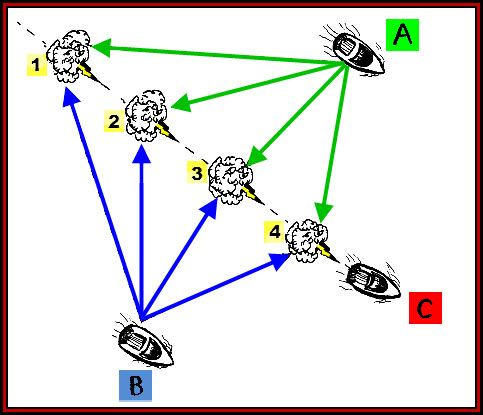
Track lightning by range and bearing with installed radar. Water droplets inside storm clouds provide excellent reflectivity for a radar signal. If you do not have installed radar, use a hand bearing compass combined with the distance method described above.
These "drift" bearings will give you an indication of storm movement. The faster the bearings drift to the left or right (see below), the better the chance that you will avoid being in the direct path of the lightning.
Follow along with the example below and illustration above.
Vessels A, B, and C are several miles apart, with lightning nearby. At Position 1, each vessel takes a bearing to the lightning on the horizon. At Position 2, Vessel A observes the lightning has "drifted" or moved to the left, which indicates left bearing drift. Vessel B observes the lightning has "drifted" or moved to the right, which indicates right bearing drift. Vessels A and B should continue to shoot bearings and calculate distance until the storm has passed (position 4 in the illustration).
Note in the idealized illustration that the distance to the storm clouds remains constant. Take care to note the range (distance) when you track lightning by radar. If you use just a hand bearing compass, you will need to estimate range (distance) by the distance methods described earlier.
Now take a look at Vessel C...
Vessel C observes that the bearing to the lightning has not changed over a series of successive bearings. This indicates "steady" (also called "constant") bearing drift--with no change in bearing. This means that the lightning may be on a collision course with Vessel C. As you can see, successive bearings serve to verify the first observation for each of these vessels.
Vessel C needs to take immediate action to avoid direct contact. One strategy would be to turn perpendicular (90°) to the lightning path, increase speed, and continue on this evasive course until he or she obtains rapid bearing drift. Regain track after the lightning has passed and no longer presents a threat to sailing safety.
If at any time, the bearing drift for Vessel A or B slows or becomes steady, or the range (distance) decreases, the skipper on each vessel would need to decide on the best defensive action to clear out of harm's way. Continue to shoot bearings and estimate range to the lightning until the threat has passed by.
3. How Can You Protect Your Small Sailboat?
The best protection comes from forming a cone over the boat, with the apex at the boat's highest point. Ground the mast to the bonding point; in sailboats, this should be the keel. Always check with the manufacturer to find out if your boat is grounded for lightning protection.
Vessels without proper grounding installations might try attaching chain, copper wire, or battery cables to the shrouds and the backstay. Feed it over the side and into the water to provide a ground path if lightning strikes.
Karen Larson ~ Why Our Sailboats are "Created Equal"
 Karen Larson and her husband Jerry Powlas started Good Old Boat years ago and they and their dedicated staff continue to put out what I believe tops the list of 'best bang for your buck' sailing magazines available. Pick up a copy of "Good Old Boat" magazine or visit their website at Good Old Boat Magazine
How did the term "moving up to a bigger boat" become so prevalent in our language? I suppose we say "moving up to a bigger house," which might then place us in a more expensive neighborhood.
Are there parallels in our sailing world? Our boats, large and small, wind up side by side in the same marinas. In fact, "moving up to a larger boat" may well exclude the new owner from any number of marinas built some time ago. The deeper draft may exclude them from some of the best anchorages, too.
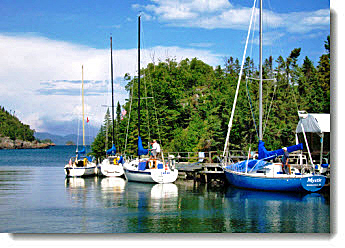
I remove that expression, "moving up," from Good Old Boat articles whenever I find it. It offends me to think that if a boater chooses to sail a smaller boat or has not yet purchased a larger boat, that sailor is therefore "down." What are we in our 20-footers if someone else just "moved up" to a 30-footer? Slum dwellers?
If our boats are right for us and the kind of sailing we do, we need have no regrets if someone else has a larger boat. There also need be no status points associated with whether that boat is new or used.
John Vigor shows us in his book, Twenty Small Sailboats to Take You Anywhere, that many smallish (20 to 32 feet) sailboats are perfectly seaworthy, capable ocean crossers. They can be handled competently by a couple, can be accommodated in any marina, and can sail into most anchorages. They're affordable, maintainable, and fun.
Used boats of this size are plentiful. Why? Because 10 and 20 years ago they were considered to be grand sailboats on every scale. The 40-footers out there were the rare behemoths in the harbor . . . noteworthy freaks for the super-rich. These sailboats could not have been classified within the group of "sailboats for the rest of us," although many of the same 40-footers fit that classification today.
Not so long ago, real people were sailing the 20- to 35-footers. When did those boats go from being advertised as family coastal cruisers and offshore sailboats to something the larger magazines now classify as "weekenders and daysailers"?
Our magazine is dedicated to the proposition that all sailboats are created equal. Bigger boats have disadvantages along with the well-touted advantages. Bigger is not necessarily better, and it is not, in our terminology, "a move up." Selecting a larger boat is a choice some sailors make. Nothing more.
Captain John's Sailing Skills Video-of-the-Week
Nothing beats neat, coiled sailing lines to keep your sheets, halyards, and sail control lines and anchor rode and docking lines ready to run through blocks and chocks smooth and easy without the hassle of kinks or knots. Watch this one-of-a-kind skipper skills video to learn more
//www.skippertips.com/snip/1149.htm
Deal-of-the-Week ~ Save Up to 40%* on Eclipse DSC+ VHF Radio!
Electronics on a sailboat need to be built tough to stand the ravages of salt air, sea spray, and driving rain. Standard Horizon meets this challenge with their line of VHF sea-tested products. You can now save 40% over list price on Standard Horizon's brand new hot-off-the-line Eclipse DSC+ VHF radio.
Features on this high-tech sailing electronics gear include...
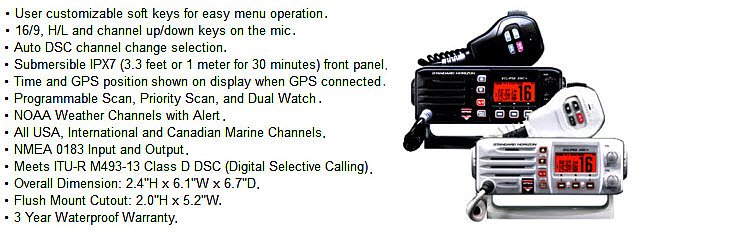
The Eclipse DSC+ is an affordable ultra compact ITU Class D VHF radio designed with a sturdy die-cast chassis making this full functioning 25 Watt radio the perfect choice for serious sailing skippers.
The microphone also features Clear Voice Noise Reduction Technology eliminating unwanted background noise like engine and wind noise during transmission ensuring clear communications. And, DSC calls can be received even when listening to other communications through a separate DSC receiver.
If you are anything like me, I want a great return policy. Horizon states that if your Eclipse DSC+ ever fails for any reason including water damage during normal use in the first three years, they'll repair or replace it free--without hassle or charges! Now, that's one super sailor's deal that will be hard to beat anywhere on the planet!
Standard Horizon Eclipse DSC+ VHF Radio Deal Details:
Deal Specs: Save up to 40%*; plus a $20 mail-in rebate**.
Deal Dates: See notes below.
Order Online: Defender Discount Offer
Order by Phone: 800-628-8225
* Savings and discounts described above are in effect at the time of this newsletter issue.
Savings and discounts are subject to change by the vendor and may change at any time.
Contact the vendor for price or discount changes prior to making a purchase decision.
** Additional $20 mail-in rebate available from Standard Horizon for
US or Canadian customers who purchase this item before July 31, 2013.
Did You Miss the Latest Member's Sailing Articles?
 Sailing Navigation Tips - Lighthouse "Sector" Secrets!
February 14, 2013 ~ Imagine that you are underway one star-filled night on a coastal sailing cruise. Just ahead off the bow, you sight the flashing white light of a coastal lighthouse. All of a sudden, that white light changes to a bright, red beacon! What action do you need to take to keep your small sailboat and her sailing crew in safe water?..
//www.skippertips.com/members/1621.cfm
Seven Sailing Navigator Safety Tips for Short-handed Sailing
February 12, 2013 ~ Sail short- or single-handed and you will have your hands full with sail trim, boat handling, vessel traffic and navigation tasks. Sure, many sailors will just follow a bug on a GPS screen. But how can you combine this with easy-to-use, almost effortless, and time tested techniques that work today, tomorrow and in the sailing seasons to come? Put some of these sound sailing seamanship tips into play today each and every time you cast off to get underway!..
//www.skippertips.com/members/1616.cfm
Could This Be Sailing's Best Navigation Tool?
February 7, 2013 ~ In my mind, nothing beats simple and fast when it comes to plotting on a small sailboat. After all, you are short handed, on a heel, and want to spend minimum time in the cabin, where navigation in rough weather can be uncomfortable. Enter the #1 tool I have used on ships, small power vessels, and small and large sailing vessels for over two decades. Read on to discover why you need this "gotta have it" navigation magic tool aboard
//www.skippertips.com/members/1363.cfm
Shorthanded Sailing Secrets - Tacking Tactics for Easier Sailing
February 5, 2013 ~ Imagine that you're sailing in a narrow channel with one hand on the tiller or wheel. You have a tack coming up in just another minute and it's going to be a handful to cast off the leeward sheet, tack the boat smooth and easy, haul in on the windward sheet and keep the boat from going into irons! What now, skipper?..
//www.skippertips.com/members/1613.cfm
Heavy Weather Sailing Advice from a Southern Ocean Veteran!
!
January 31, 2013 ~ Did you know that in heavy weather sailing, it is not necessarily the size of a wave that makes it dangerous but the shape of it? What sail combinations will keep you, your sailing crew or partner, and your small sailboat safe in high winds and rough seas? Today, a blue-water sailing veteran with thousands of miles in the Southern Ocean shares his thoughts on sailing safety in rough weather!..
//www.skippertips.com/members/650.cfm
Sailing Skipper's Quotable Quotes...