Did know that many sailing deliveries are to upwind destinations? And on a delivery where time can be a factor, skippers often use the diesel engine a large percentage of the time. Sail and powerboat heavy weather tactics are similar. Follow these five easy sailing tips to learn how you can ease the stress on your sailboat, deck gear, and sailing crew when you need to power against a stiff wind and sea!"...
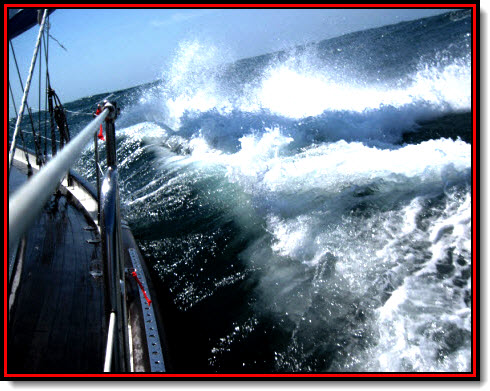
In heavy weather, prepare to deal with rolling (side to side) and pitching (up and down) motion. First and foremost, know the capabilities of your crew and cruising boat. Then follow these five tips to maintain positive boat control:
1. Use "Course-Averaging" for Easier Sailing Courses
Whether you have autopilot or not, you will want your sailing crew or partner to know how to average the desired sailing course when steering in rough weather. Legendary yachtsman and author John Mellor says you will do well to steer a course within five or ten degrees in rough weather. So, it makes more sense to steer an average course than to fight the helm to try to steer an exact course.
Steer to one side of the desired track for a certain number of degrees for a set interval of time; then steer the same amount on the other side of the desired course for the same interval of time. For example, you might steer five degrees "high" on the sailing course for ten minutes; then steer five degrees "low" on the sailing course for ten minutes. This technique still provides an accurate course over ground and your sailing crew or partner will be less fatigued at the wheel or tiller. (also see "Related Articles below)
2. Tack on Upwind Courses
For upwind destinations, powerboats should tack across the seas like a small sailboat. Keep the sea waves 35 to 45 degrees off your bow. Don't allow the boat to turn beam to the seas. This increases rolling. In breaking seas, the boat could broach (roll onto her side and capsize). Use lots of helm and adjust your throttle speed to keep the bow angled to the seas for a smoother ride.
3. Slow Down to Ease the Ride
Slamming through seas creates enormous stress on the hull; fatigues even the saltiest seaman and could cause injury. Reduce speed and you will be surprised how quickly the ride and crew morale improve!
4. Shift Weight Away from the Bow
Heavy marine anchors and ground tackle in the bow cause pitching, or up and down motion. This could cause "wave plunging", where the bow dives into the next wave ahead. The boat shudders, the bow fills with blue water and your boat slows to a crawl. Pitching also increases the incidence of seasickness among the crew. Shift weight toward the center of the boat and keep it low to help resolve pitching problems.
5. Reduce Yawing when Running Downwind
A vessel will often yaw--swing in a horizontal plane from side to side--when heading downwind in rough seas. Use a triple dose of anti-yaw medicine to put this ugly motion to bed. Reduce speed, increase weight aft, and keep off the face (forward part) of breaking waves.
Small cruising sailboats sometimes tow warps (long bights of line) from the stern to help keep the stern square to the sea waves. If you choose to do this under power, attach flotation all along the warp to prevent the line from fouling the propeller.
~~~~~~~~~~~~~~~~~~~~
Few small boat cruising skippers relish the thought of getting caught out in tough marine weather. But with these five tips, you will have the skills and knowledge to get through it with flying colors!
Sailing Video ~ How to Rig an "Anti-Snag" Anchor Tripline!
Mark your anchor location to warn other boats or make it easy to retrieve your anchor in the morning. How can you accomplish both of these two tasks quick and easy? Use an anchor trip line for peace-of-mind wherever you anchor. Watch this exclusive sailing skills video to learn more! Click Here to Watch the Video
Deal-of-the-Week ~ Save Up to 40%* on Eclipse DSC+ VHF Radio!
Electronics on a sailboat need to be built tough to stand the ravages of salt air, sea spray, and driving rain. Standard Horizon meets this challenge with their line of VHF sea-tested products. You can now save 40% over list price on Standard Horizon's brand new hot-off-the-line Eclipse DSC+ VHF radio.
Features on this high-tech sailing electronics gear include...
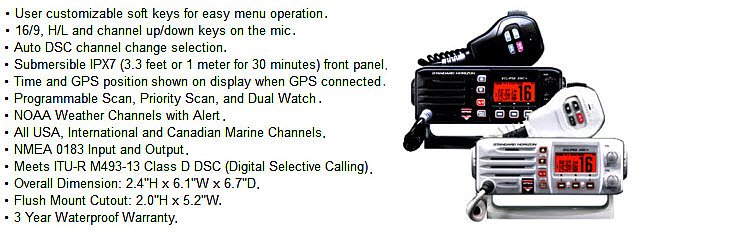
The Eclipse DSC+ is an affordable ultra compact ITU Class D VHF radio designed with a sturdy die-cast chassis making this full functioning 25 Watt radio the perfect choice for serious sailing skippers.
The microphone also features Clear Voice Noise Reduction Technology eliminating unwanted background noise like engine and wind noise during transmission ensuring clear communications. And, DSC calls can be received even when listening to other communications through a separate DSC receiver.
If you are anything like me, I want a great return policy. Horizon states that if your Eclipse DSC+ ever fails for any reason including water damage during normal use in the first three years, they'll repair or replace it free--without hassle or charges! Now, that's one super sailor's deal that will be hard to beat anywhere on the planet!
Standard Horizon Eclipse DSC+ VHF Radio Deal.
Deal Specs: Save up to 40%*; plus a $20 mail-in rebate**.
Deal Dates: See notes below.
Order Online: Defender Discount Offer
Order by Phone: 800-628-8225
* Savings and discounts described above are in effect at the time of this newsletter issue.
Savings and discounts are subject to change by the vendor and may change at any time.
Contact the vendor for price or discount changes prior to making a purchase decision.
** Additional $20 mail-in rebate available from Standard Horizon for
US or Canadian customers who purchase this item before July 31, 2013.
Did You Miss the Latest Member's Sailing Articles?
 Sailing Secrets - Ten Golden Rules of Standing Watch Under Sail
January 24, 2013 ~ Learn to sail like a pro with these ten golden sailing tips. I believe nothing gives peace-of-mind to a sailing skipper when you know that the person on deck after dark will be alert, awake, and attentive to the duties of an effective watchstander. Follow these ten tips to keep safe and sound on the waters of the world...
//www.skippertips.com/members/1595.cfm
Free Report with This One-Minute Sailing Rope Survey!
January 22, 2013 ~ Step aboard any boat--sail or power--and you enter a world different than any other on the planet. You will want to equip yourself with the best sailing safety tools available. Did you realize that you can use the blade or blunt part of any sailing knife to make sailing tasks faster and easier? Download this exclusive, free report now.....
//www.skippertips.com/members/1587.cfm
Sailing Secrets - Lessons Learned from a Deadly Storm!
January 17, 2013 ~ Imagine that you approach the harbor entrance to a major city on a calm, but black, starless night. You strain your eyes through binoculars to search for the line of buoys that mark the approach--and see nothing. No flashes. No lights. You sweep to the right and left to look for the city lights--and see nothing. No signs of life anywhere. What now, skipper?..
//www.skippertips.com/members/1593.cfm
Sailboat Anchoring Secrets - A New Look at Anchoring Under Power !
January 15, 2013 ~ Sailboat anchoring remains one of the great pleasures of cruising. And most folks tend to anchor under power. It may seem simple as pie. Stop, drift, drop, reverse. But is there a better more controlled way to set the hook deep and secure. Captain Alex Blackwell, in his blockbuster "Happy Hooking - The Art of Anchoring" has a unique, controlled technique that you will want to know. Try it out the next time you lower your sailboat anchor under power for even more peace-of-mind...
//www.skippertips.com/members/1589.cfm
Sailing Navigation Safety - Will Your Mast Clear Those Overhead Power Cables?
January 10, 2013 ~ Sail or motor in inland waters and you will encounter power cables strung from one side of a narrow waterway to the other. How can you determine if your mast and her attachments will clear a cable or high-voltage wire, just by a quick glance at your nautical chart? Follow this quick guide to identify these vital sailing navigation chart symbols!..
//www.skippertips.com/members/1584.cfm
Sailing Skipper's Quotable Quotes...