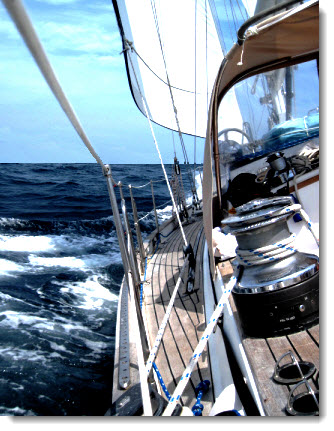
Have you ever seen your sailing crew or partner struggle to "keep the sailing course" after only 2 to 3 minutes at the wheel or tiller? Steering can be tough on a gusty beam reach or a beat in a chop where the boat wants to round up. Even after you reduce sail, staring at a compass can cause eye strain and excess fatigue.
Use this unique little-known technique described below to steer super accurate courses and keep the task of steering easier and less tiring for your sailing crew! Enjoy this excerpt from Captain John's new eBook "101 Secret Sailing Tips"...
Can you imagine driving your car down the highway with your eyes glued to the speedometer? No one does this. Instead, you use a natural, built-in "judgment-meter" to know when to accelerate or decelerate. Once in a while, you glance at the speedometer to fine tune your progress.
Use this same principal with pick-a-point (P.A.P.) steering. Follow one of these three methods based on whether you sail in inland waters, offshore or during nighttime.
Inland P.A.P. Steering
1. Steady up onto your compass course with the steering compass.
2. Glance ahead, pick a distant object, and steer on it. Superimpose the object against some fixed part of your small cruising boat (mast, stay, shroud, pulpit, stanchion).
3. Check your steering compass every 30-45 seconds. A quick glance should be enough. Repeat steps 1 and 2 to fine tune your heading.
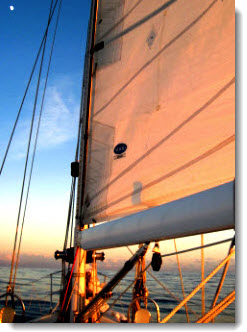
1. Steady up onto your compass course with the steering compass. In seas, average your course above and below the sailing course. This causes less fatigue.
2. Pick a distant irregular land point if steering toward shore. This might be a hump, gap, or peak in a tree line, group of hills, cliffs, or mountain range. Line up a fixed object with a cloud at sea. Shift to a new cloud or group of clouds often.
3. If clouds are absent, maintain a constant angle with wind-blown whitecaps, use shroud telltales, or feel the wind on your face. All of these methods help when you are out of sight of land.
Check your steering compass every 30-45 seconds. If you average your course, remember that you must keep an eye on your watch for accuracy (see "Related Articles" below for more on course averaging while sailing).
Nighttime P.A.P. Steering
1. Steady up on your compass course.
2. Pick a star higher up off of the horizon. That way, the star cannot be mistaken for a ship's white masthead lights. Place the star along your boat's mast, stay or shroud.
3. Check your compass every 30 to 45 seconds. Take care not to get lulled into following a star across the ocean! Pick a new star to keep on your sailing course.
~~~~~~~~~~~~~~~~~~~~
Pass along the secret of pick-a-point steering to your sailing crew or partner to reduce fatigue and effort. You will benefit from more accurate sailing navigation courses aboard your sailboat--wherever in the world you choose to sail or cruise!
Connie McBride on Cruising Bocas del Toro, Panama
 Connie McBride, her husband Dave, and their three young boys sailed away from the dock in 2002 in their 34' Creekmore Eurisko. Together they explored the Caribbean as the boys grew up and moved out one by one. Today, Connie tells you about the unique paradise cruising ground called Bocas Del Toro, Panama. Find out more about Connie's cruising adventures in her new audio book "Eurisko Sails West: A Year in Panama"
 After 11 days at sea, I thought my tired eyes were playing tricks on me as we sailed into the channel toward Bocas del Toro. Is that really a dugout canoe? For the next year, Panama continued to amaze us. It has so much more to offer than just a passageway between oceans.
Bocas del Toro is the name of the western-most province on the Caribbean side of Panama (boaters often call the entire 200 island archipelago Bocas del Toro). It's also the name of the town located on the largest island, Isla Colon, frequently referred to by the locals as Isla Bocas. Whatever you call it, the area is spectacular.
With a population of 4300, Bocas town has the look, feel and services of a much larger town, without losing its charm. Dive shops and restaurants reside next door to dugout canoes (called "cayucos") unloading their cargo of plantain.
The people are no less varied. The local Ngöbe-Buglé Indians sit with the Panameños in the park; West Indians mingle with the expatriated Americans at the bar; I was in line at the bank behind a Kuna Indian woman. German, Swiss, French, British, Turkish, Israeli, Greek and Argentinean tourists share a table to eat a $3.25 dinner of stewed chicken, rice and beans and cole slaw.
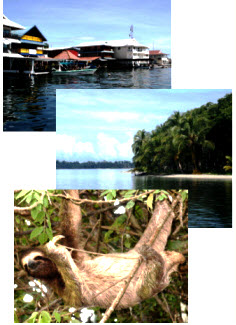
Near Bocas town are a few marinas and anchorages. But for us, the greatest appeal of Bocas del Toro isn't the places to stay, but the places to go. The first three months we were in Panama, we sailed 21 times--a total of 220 miles--all within the archipelago. Each time we dropped anchor, we were impressed by the diversity of scenery, wildlife, and even climate in such a small area.
When we wanted to witness the local Indian culture more closely, we sailed into Trouble Hole, on the west side of Isla Cristobal, just south of Bocas. As the wind died and we ghosted in, we heard drums in the jungle, then singing. We saw smoke and heard the rhythmic beating of an ax on wood.
After the heat and stillness of anchoring in the mangroves of Trouble Hole, Agama Cay was a pleasant surprise. Anchored off the mainland, at the base of a mountain chain containing Panama's highest point (only 30 miles away), we frequently needed sweatshirts in the evening. Even during the day we often had a cooling breeze.
When I was ready for a change of scenery and wanted to go snorkeling, we sailed to Gallego Cays, 6 miles southeast of Bocas. This area of low, mangrove-covered cays offers several anchoring choices and reefs to snorkel.
Even the jungle is a short sail from Bocas. Five miles up the west coast of Isla Colon is Big Bight. Though it is in our cruising guide, we never saw another boat anchored there. As we sailed in, we could hear howler monkeys and the distinct call of oro pendula.
By boat from Bocas del Toro, most cruisers go to Colon, the San Blas Islands, and then "Cartagena by Christmas". Others cross through the canal to explore the Pacific. Some, like us, island hop up the Caribbean coast of Central America. With no hurricanes, the typical seasonal Caribbean push to move does not exist, making it hard to leave Panama.
Video of the Week ~ Use This "Rule" to Pass a Deadly Reef!
How can you make sure that you will clear rocky shoals ahead if you sail in an area with spotty GPS coverage or your GPS fails to function while coastal sailing? Here's one super simple calculation that takes just seconds to help keep your small sailboat in safe water. Click Here to Watch the Video
Deal-of-the-Week ~ Save Up to 39%* on Mustang Survival Gear!

Mustang Survival has been providing top quality, tough sea gear for sailors and rescue experts for decades. We wore their gear in hundreds of search and rescue missions in the US Coast Guard.
Mustang tops my list of "best of the best" when it comes to personal flotation devices (pfd), exposure suits, or immersion suits. After all, your sailing gear needs to protect you and your crew in a squall, gale, or raging storm.
Now, Defender Industries offers deep discounts of up to 39%* off list price on the Mustang's high tech M.I.T. 35 automatic inflatable pfd.
This super sailing gear has the latest "next generation" of lightweight flexible fabric that moves with your body for better mobility and flexibility--super important when you need to change out sails, tuck in a reef, grind on a winch, or lower or weigh anchor.
The M.I.T. 35 is automatically activated upon immersion and provides 35 lbs. of buoyancy - more than twice the flotation of a traditional pfd. And that's not all...
This pfd features an inflator inspection window and an access flap to make inspecting and maintaining your pfd a breeze. The pfd includes a separate hidden pocket for convenient storage, a safety whistle and a reflective badge for enhanced visibility.
Give Defender a call or order online (see contact info below). This super sailor deal will be hard to beat!
Mustang M.I.T. 35 Inflatable PFD Deal.
Deal Specs: Save up to 39%* off of list price.
Deal Dates: See *NOTE below.
Order Online: Defender Discount Offer
Order by Phone: 800-628-8225
*NOTE:
Savings and discounts described above are in effect at the time of this newsletter issue.
Savings and discounts are subject to change by the vendor and may change at any time.
Contact the vendor for price or discount changes prior to making a purchase decision.
Did You Miss the Latest Member's Sailing Articles?
 Sailing Navigation Safety - Will Your Mast Clear Those Overhead Power Cables?
January 10, 2013 ~ Sail or motor in inland waters and you will encounter power cables strung from one side of a narrow waterway to the other. How can you determine if your mast and her attachments will clear a cable or high-voltage wire, just by a quick glance at your nautical chart? Follow this quick guide to identify these vital sailing navigation chart symbols!..
//www.skippertips.com/members/1584.cfm
Ten Sailing Tips to Prepare for Sailing Season 2013
January 8, 2013 ~ Is your small sailboat and sailing crew prepared for the challenges that might pop up while on a coastal cruise this coming year? Have you thought through the "what if" scenarios and come up with a plan of action? Follow these ten sailing tips for safer sailing throughout the new year--wherever in the world you choose to sail or cruise!..
//www.skippertips.com/members/1581.cfm
Protect Sailing Rope with This "Sixty-Second" Sailing Whipping!
January 3, 2013~ What little-known sailing knot will protect your costly sailing rope from fraying, serve as a marking for anchor rode, and takes less than 60 seconds after just a bit of practice? Any sailor worth their salt will want to know this knot that will serve you well aboard any boat--wherever in the world you choose to sail or cruise!..
//www.skippertips.com/members/1579.cfm
Catch This "Mainsail Killer" to Save Repair Costs!
January 1, 2013 ~ Do you know the single most common sail repair among cruising folks worldwide? Torn or ripped sails? Nope. Broken sail slugs or slides? Not that either. Learn the secrets of the master sailmakers to find out how you can prevent costly damage or make quick repairs to this vital area of your powerhouse mainsail!..
//www.skippertips.com/members/1574.cfm
Three Emergency Sailing Tips You Can Use Inside a Marina!
!
December 27, 2012 ~ Imagine that you are on the final approach to your marina after a fine day of sailing. All of a sudden, your small sailboat engine sputters, gasps, burps, and dies. You push the starter button again and again--but nothing happens. You need to regain control right ways to avoid costly damage to yachts and property! Now what, skipper?..
//www.skippertips.com/members/1567.cfm
Sailing Skipper's Quotable Quotes...