Learn to sail like a pro when you know the five vital signs of reefing. We've all heard the saying to "Reef when you first think about it", but it's also one of those rules that can be tough to follow through with.
These easy steps will help you take the guess work out of when to reef. Use these on any boat in any weather so that you can make an informed decision for maximum sail power and crew comfort when the rough stuff arrives! ...
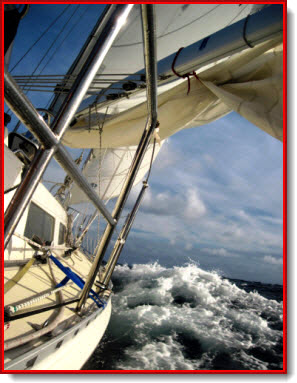
Why Reefing Reaps Big Benefits
Realize that heavy weather is a relative term. I have never believed in setting wind speeds or sea state for all boats. A 25 to 30 knot breeze in 4 to 5 foot seas could mean fine sailing for a 50 foot sailboat of moderate to heavy displacement with just a single reef (or no reef) tucked in.
But in the same conditions, a lighter displacement 25 foot sailboat could have reached the limits of her "sailability", even with two reefs tucked in and a storm jib hoisted forward.
Reduce or reef sails early enough to keep the boat sailing with minimum heel. This action will flatten the boat, decrease the amount of steering necessary to keep on a sailing course, and increase sailing performance (forward drive and speed). This will lower fatigue and increase comfort for your sailing crew or partner.
Famous sailor and author John Rousmaniere states that about 3° should be the maximum off-center that a wheel or tiller should be held. Use this as a benchmark; some boats may require a bit more than this. But in any event, the helm should feel light and it should be easy to maintain the sailing course with just fingertip pressure. This applies in all weather--from the lightest zephyr to extreme conditions.
Five "Reef-Right-Now" Signals!
Follow these five golden rules so that you know when to reef. Be the first one out there to take action. Tucking in a reef while heeled over with spray flying in your face can be tough on even the saltiest of sailing dogs. Can you answer Yes! to one or more of the questions below? If so, then it's time to tuck in a reef or two or three. Do it now, skipper!
1. Whitecaps to Windward?
Constant whitecaps that cover most of the sea to windward tell you that a strong breeze has filled in and will continue for some time. Reef to add power to your boat sails and punch through those waves like a hot knife through butter.
2. Gusts More Frequent?
How often do those gusts strike the sails and cause the boat to heel? An occasional gust might not be of much concern. But lots of gusts every minute mean you need to reduce sail to keep the boat on her feet.
3. Helm Hard to Hold?
Stated above, but worth a reminder. No boat--no matter her size or configuration--will be balanced with a heavy helm. Use this as a key element in all of sail trim--moderate or heavy air.
A balanced helm means being able to steer without strain with one hand. Lots of weather helm and "white-knuckles" on the wheel or tiller indicates a boat out of harmony with wind and sea. Reef sails to the point that your boat can almost steer herself with just fingertip pressure to hold the helm on course!
4. Rail Digging In?
Each time your small cruising or racing sailboat digs the leeward rail into the water, you lose valuable speed. Extra friction and drag make you slow down. Keep the lee rail clear of the water for faster cruising passages.
5. Crew Fatigued and Sick?
All evolutions take longer to complete in tough weather. A tired, sick crew can become an injured, battered crew. One crew member unable to stand watch increases the work load on all hands. Tuck in a reef and you will be rewarded with a boat that sails flatter, pounds and pitches less, and reduces crew fatigue.
~~~~~~~~~~~~~~~~~~~~
Follow these five simple sailing tips to balance your boat and keep her on her feet in heavy sailing weather. You will reap the benefits of better performance and more sailing crew comfort--wherever in the world you choose to sail or cruise!
Karen Larson on What You Might Find on a "Monday" Sail
 Karen Larson and her husband Jerry Powlas started Good Old Boat years ago and they and their dedicated staff continue to put out what I believe tops the list of 'best bang for your buck' sailing magazines available. Today, Karen passes along a humorous tale about a sail modification. Pick up your copy of "Good Old Boat" magazine at Barnes & Noble or visit their website at Good Old Boat Magazine
When Sailrite began building sails once again (rather than selling just kits for home assembly), we ordered two jibs for our brand-new roller furler. These sails were excellent in every way...except for one minor detail in the smaller one.
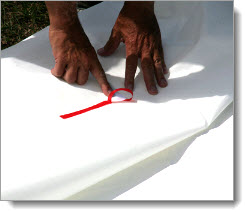
We hear tales of automobiles and other products assembled just after a worker's weekend festivities or in anticipation of them with some attention to detail lacking.
Another friend, a sailmaker, has told us time and time again that the color of telltale should not matter. Any leftover spinnaker cloth should do no matter whether it's teal, orange, or purple. We agree in principle. But if the telltales are red and green shouldn't they be located on the appropriate side?
We joked about the reversed telltales last year during the first season with our new furler and we got used to their idiosyncrasies. Besides, we used the larger jib (a 155 percent) for most of that year's cruise.
This year, we'd forgotten all about the reversed telltales and got the giggles all over again when flying that sail. Then we spread it out on a yacht club lawn and put our own replacements on. Once we had the sail spread out flat we realized how easy it would be to confuse the sides of the sail and accidentally reverse the telltales. It was a simple mistake to make and a simple mistake to fix.
In every other way this jib was perfect as delivered. And now that we have the green telltales to starboard and red ones to port, it's absolutely perfect, even if it was -- perhaps -- a Monday sail.
Video of the Week ~ Tie the "King of Joinery"!
Need a sailing knot to join two pieces of line together fast and easy? Make a longer docking line for springing your boat alongside a pier or make up a longer heaving line to toss to a person in the water. You'll be able to tie this sailing knot in just ten seconds with practice! Grab some line and tie this sailing knot now! Click Here to Watch the Video
Deal-of-the-Week ~ Save Up to 45%* on Mustang Survival Gear!

Mustang Survival has been providing top quality, tough sea gear for sailors and rescue experts for decades. We wore their gear in hundreds of search and rescue missions in the US Coast Guard.
Mustang tops my list of "best of the best" when it comes to personal flotation devices (pfd), exposure suits, or immersion suits. After all, your sailing gear needs to protect you and your crew in a squall, gale, or raging storm.
Now, Defender Industries offers deep discounts of up to 45%* off list price on the Mustang's high tech M.I.T. 35 automatic inflatable pfd.
This super sailing gear has the latest "next generation" of lightweight flexible fabric that moves with your body for better mobility and flexibility--super important when you need to change out sails, tuck in a reef, grind on a winch, or lower or weigh anchor.
The M.I.T. 35 is automatically activated upon immersion and provides 35 lbs. of buoyancy - more than twice the flotation of a traditional pfd. And that's not all...
This pfd features an inflator inspection window and an access flap to make inspecting and maintaining your pfd a breeze. The pfd includes a separate hidden pocket for convenient storage, a safety whistle and a reflective badge for enhanced visibility.
Give Defender a call or order online (see contact info below). This super sailor deal will be hard to beat!
Mustang M.I.T. 35 Inflatable PFD Deal.
Deal Specs: Save up to 45%* off of list price.
Deal Dates: See *NOTE below.
Order Online: Defender Discount Offer
Order by Phone: 800-628-8225
*NOTE:
Savings and discounts described above are in effect at the time of this newsletter issue.
Savings and discounts are subject to change by the vendor and may change at any time.
Contact the vendor for price or discount changes prior to making a purchase decision.
Did You Miss the Latest Member's Sailing Articles?
 Protect Sailing Rope with This "Sixty-Second" Sailing Whipping!
January 3, 2013~ What little-known sailing knot will protect your costly sailing rope from fraying, serve as a marking for anchor rode, and takes less than 60 seconds after just a bit of practice? Any sailor worth their salt will want to know this knot that will serve you well aboard any boat--wherever in the world you choose to sail or cruise!..
//www.skippertips.com/members/1579.cfm
Catch This "Mainsail Killer" to Save Repair Costs!
January 1, 2013 ~ Do you know the single most common sail repair among cruising folks worldwide? Torn or ripped sails? Nope. Broken sail slugs or slides? Not that either. Learn the secrets of the master sailmakers to find out how you can prevent costly damage or make quick repairs to this vital area of your powerhouse mainsail!..
//www.skippertips.com/members/1574.cfm
Three Emergency Sailing Tips You Can Use Inside a Marina!
!
December 27, 2012 ~ Imagine that you are on the final approach to your marina after a fine day of sailing. All of a sudden, your small sailboat engine sputters, gasps, burps, and dies. You push the starter button again and again--but nothing happens. You need to regain control right ways to avoid costly damage to yachts and property! Now what, skipper?..
//www.skippertips.com/members/1567.cfm
Sailing Emergencies -- Make a "Two-Step" Pump for Flooding Emergencies!
December 25, 2012 ~ Being prepared for sailing emergencies always makes good sense. And flooding ranks a close 2nd just behind fire as one of the most dangerous sailing situations. Many members asked if there was a more permanent way to rig the engine de-watering pump discussed in an earlier newsletter. Read this sailing tip to learn a super fast "two-step" alternative!..
//www.skippertips.com/members/1563.cfm
This Navigation Safety Signal Could Prevent a Collision!
December 20, 2012 ~ Imagine that you are sailing or powering down a long winding channel with lots of turns and bends. Up ahead you see a point of land that juts out into the channel. Out of nowhere, you hear a loud, ear-splitting fog horn on the other side of the point of land! What action should you take right away to avoid danger to your sailing crew and small sailboat?..
//www.skippertips.com/members/1560.cfm
Sailing Skipper's Quotable Quotes...