


In Today's Issue:
* It's Your Call, Skipper! ~ "Sail Past a Deadly Reef with Confidence"
* Video-of-the-Week ~ "Tie This Sailing Knot in Ten Seconds"
* Special Guest Article ~ "Cleaning Secrets for Cruising Sailors"
* Did You Miss the Latest Member's Sailing Articles?
* Super Deals and Discounts for Sailors! * NEW FEATURE! *
* Sailing Skipper's Quotable Quotes
* Recommended Reading for Sailing Season 2012
=============================================================================================
"It's Your Call, Skipper!"
Sail Past a Deadly Reef with Confidence

just six miles dead ahead of your small cruising sailboat.
And you have just one more hour before sunset.
You need to clear the reef by at least five miles...
Did you know that you can make a fast and accurate calculation...
to find out how many degrees to change your course--in just seconds?
~~~~~~~~~~~~~~~~~~~~
Learn this little-known, fast and easy coastal navigation technique and you will be able to:
Use the "Rule of 60" to give you a safe sailing solution fast. This will take you no more than ten seconds, and it's accurate, and can be done without a lot of chart work. To remember how to perform this calculation, use this memory aid: 60Do/Da (pronounced "Sixty-Doo-Dah"). Silly as it might sound, this memory aid will help you remember the steps to make this calculation, even after weeks or months. Follow these five easy steps:
1. Determine the Distance Off (Do)
Check the nautical chart and determine how close you want to pass the hazard. Leeway, or side-slip, makes a big difference in small cruising sailboats. Choose the downwind or down current side if your chart shows that side to be safe.
2. Measure the Distance Ahead (Da)
How far ahead is the hazard? Base this calculation on when you make your turn. For instance, if you plan on making the turn in five minutes, project ahead where your position will be in five minutes. Then measure the distance to the reef from that point. This adds a safety factor for peace-of-mind.
*Note*
Make sure that the Do and Da numbers are different. The calculation will not work if they are the same. For example, you do not want to use a Do of 6 miles and Da of 6 miles. Choose a different number for your Do to avoid this (see example below).
Multiply 60 times your distance off. Remember that distance will be how far you want to stay off of the danger. This is the "60Do" part of the memory key.
Next, you will divide the result by the distance ahead. This is the "Da" part of the memory key. Now look again at the memory key once again: "60Do/Da". 60 times distance off (Do) divided by distance ahead (Da) will give you the number of degrees you need to change course.
4. Apply the Degrees to the Compass Course
Take care to apply the degrees to your compass course in the correct direction. Use this memory aid:
REEF-RIGHT-REDUCE
REEF-LEFT-ENLARGE
* To keep the reef to the right (starboard) side of the boat, REDUCE (Subtract) the degrees from your sailing course.
* To keep the reef to the left (port) side of the boat, ENLARGE (Add) the degrees to your sailing course.
5. Check the Chart Again
Look at your chart one more time. Measure the new course and see if it makes sense. If it doesn't, stop or heave-to until you get oriented and understand the navigation picture.
Backup your calculations with a final check on your nautical chart. Tired sailors make blunders. I've made dozens of errors that were caught at the last minute after double or triple checking my work--or having another check it. Check twice before you commit!
Example to Use with the Illustration
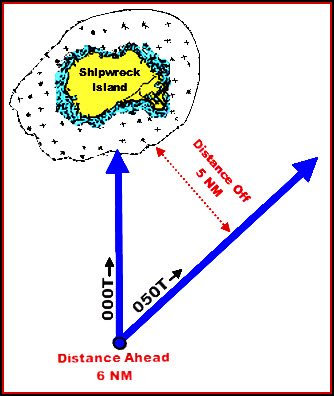
You are northbound in the Bahamas, reaching on port tack in a brisk northwesterly breeze. You are on a course of 000° true (we will use true direction in this example and convert to magnetic direction later).
Six miles ahead lies a large coral reef. You check the chart and decide that you want to keep five miles off of the reef and keep the reef on your left (port) side as you pass.
60 X 5(distance off) = 300 / 6(distance ahead) = 50°. We want to keep the reef to our left. In this case, you would add 50° to your course. 000° + 50° = 050° degrees true. Apply variation to convert this true course to a magnetic course. Remember to add westerly and subtract easterly variation to find the magnetic course (see "Related Articles" below for more on how to find and use variation).
~~~~~~~~~~~~~~~~~~~~
Practice the "Rule of 60" to gain the confidence and skill you need to pass any dangerous reef that lies ahead in your path. Keep your sailing crew and small sailboat safe and sound with sailing tips like these--wherever in the world you choose to cruise!
Discover more navigation and sailing techniques like these to save time and effort when short handed sailing in the exclusive, members-only eBook Coastal Navigation Quick-Tips. Access over 13 eBooks as a Skippertips member. See details below.
=============================================================================================
Captain John's Sailing Skills Video-of-the-Week
 Need a sailing knot to join two pieces of line together fast and easy?
Make a longer docking line for springing your boat alongside a pier...
or make up a longer heaving line to toss to a person in the water.
You'll be able to tie this sailing knot in under 10 seconds with practice!
Grab two pieces of line and learn to tie this super knot now!
Click on the big button to the left to see how.
Note - This video is formatted to play on any computer or mobile device.
Please allow a few seconds for the video to load onto your personal device.
=============================================================================================
Ask the Detailer - Cleaning Secrets for Cruising Sailors!
 "Ask the Detailer" is written by Natalie Sears, owner of Deckhand Detailing in Seattle WA. Natalie is the author of "The Insider's Guide to Boat Cleaning and Detailing". Visit her highly informative website at www.DeckhandDetailing.com for resources, product reviews and ask questions on how to keep your boat hull, deck and teak in tip top shape all sailing season long.
While you're out and about this summer cruising over a long weekend or even a few weeks, there are certain things you want to make sure you bring, such as sunscreen, seasickness pills, a good book and games for the kids. But don't forget those few boat cleaning items that will make cleaning or washing your boat a quick and easy task each time you pull into port.
Exterior Cleaning
Before you leave on an extended excursion, you should go through your lazarettes and other storage compartments and throw out or remove from the boat those things that are old, that you no longer need or that you won't specifically be using for this cruise. This will make room for the things you do need and make it easier for you or others to find those things when they're needed.
For your exterior cleaning gear, you should have the following items stored in one of the aft storage compartments:
When you pull into the slip at the marina you're visiting, get your wash gear set up and quickly hose off the entire boat, including windows. If it's a hot and sunny day, this will save you some headache later. The faster you can clean those salty windows, the better. Unfortunately, salt doesn't come off completely by simply pointing a hose at it. A salty residue will remain that can become etched into your gel coat and both glass and plastic windows. You may not see it very well on white or off-white gel coat, but you'll see it quite easily on dark colored hulls.
Once you've hosed the boat off, fill your bucket and grab your deck brush with the soft brush attachment to wash your boat with. If you don't have much time, spend most of your time on the glass and plastic windows. Even after washing them with soap and water, you'll still see salt spray or water spots on them. This is what the microfiber rags are for. Use these to wipe off the remaining salt or water spots from the windows.
Use the Mr Clean magic pads to remove marks and stains from the non-skid, but don't use these handy little cleaning pads on smooth gel coat or it will remove any coating of wax you have in that area and dull the finish. To remove a stain or scuff mark on smooth gel coat, use a rag with some cleaner wax and rub it off, then wipe the haze away.
Interior Cleaning
There are a few items you should store in an easily accessible storage compartment inside your boat so you can take care of spills or messes soon after they happen. This will help prevent stains from setting in and doing quick cleanings along the way can help prevent your living and sleeping areas to require more in depth cleaning that takes you away from time spent with your family and friends or sightseeing.
Store these items in one handy place and let everyone on board know where they are so anyone can spot clean as needed (although I realize that the dog and kids won't necessarily be the most proactive spot cleaners). You may also want to buy a few carpet runners to lay down in high traffic areas if you don't already have canvas carpet runners snapped in place over your carpets.
Use the to do more than just keep carpet clean -- use it to suck up hair in the shower or head area as well as make crumbs on both the floor and counters disappear. Microfiber rags are also great for cleaning counter spaces because everything sticks to them, especially crumbs. Buy a multi-purpose spray cleaner such as SprayWay so you only need to grab one cleaner for all surfaces, whether it be windows, granite or wood.
A container of disinfecting wipes is quick and easy to use in the head area, as well as in the kitchen and on door handles or knobs and table tops. Not only does it disinfect, but it also cleans and helps remove sticky messes.
If something hits the carpet that creates a stain, try to remove it as quickly as possible. Keep a carpet cleaning spray on hand such as Folex or any of the "oxy" type carpet cleaners, as well as a small scrub brush or even an old toothbrush. First try to blot as much of the stain out as you can with warm water and a rag.
If a stain still persists, spray the area with the carpet cleaner, brush it in with the brush and then blot dry. Place a paper towel over that area so no one steps on it with dirty feet or shoes until it's completely dry, otherwise fresh dirt may "stick" to the wet area and only make it harder to remove in the future.
With a simple checklist and action plan like this, you'll be able to prevent a lot of stains or salt and water spots from setting in and becoming more difficult to remove once you return home. But more importantly than stains or water spots, have fun, be safe and enjoy your outing!
=============================================================================================
Did You Miss the Latest Member's Sailing Articles?
 Use Natural Ranges for Safer, Easier Sailing Navigation!
August 2, 2012 ~Imagine that your GPS plotter goes on the blink while cruising. You need to enter an unfamiliar harbor. How can you prepare your nautical chart with the power of "natural ranges" to avoid running aground, keep in safe water, or check your steering compass in just seconds? Read on to learn more about this powerful coastal navigation technique!..
//www.skippertips.com/snip/1094.htm
Make Learning to Sail Faster with Just Three Points of Sail!
July 31, 2012 ~ Learning to sail can be a tough uphill battle with all the names given to various points along a circle. How can this be made easier in order to learn faster--yet retain the same high standard of accuracy and knowledge? I believe a reduction in "points" to just three may be the answer. With a new crew or partner aboard, try this new method with him or her...
//www.skippertips.com/snip/1093.htm
Heavy Weather Sailing - How to Contain the Reefed Mainsail Foot
July 26, 2012 ~ Learn to sail like a pro with sailing tips that keep your sails in top shape and avoid damage. I received a great question the other day from a skipper about what to do with all the excess mainsail (bunting) along the foot after you reef. Should you tie it up or leave it alone?
//www.skippertips.com/snip/1092.htm
Does Sailboat Docking Line Size Make a Difference?
July 24, 2012 ~ Learn to dock a boat like a pro when you match your docking lines to your sailboat. This will give you more robust chafe protection and help protect your costly deck fittings from excess loads. Follow these three simple sailing tips for more peace-of-mind this sailing season whether you tie up alongside a pier, wharf, or inside a boat slip...
//www.skippertips.com/snip/1091.htm
How to Get FREE Sailing Guides for Cruising Outside of US Waters!
July 19, 2012 ~ Nothing beats the price of FREE when it comes to navigation publications. Are you planning a cruise or charter to the Caribbean, in Europe, Scandinavia, or the Mediterranean? Look no further than this treasure chest of information to save big dollars--because it has the low, low price of FREE!..
//www.skippertips.com/snip/1089.htm
=============================================================================================
Sailing Skipper's Quotable Quotes...
 At all times, the nautical chart must agree with the visual picture that surrounds you.

-- Captain John,
from 'Seamanship Secrets'
from International Marine / McGraw-Hill
 "You will be in the hands of an experienced and trusted guide."
-- Daniel Spurr, former senior editor of Cruising World magazine
"Written so clearly that navigation and seamanship will be comprehensible to anyone."
-- Dave and Jaja Martin, circumnavigators and authors
"It should be read by anyone contemplating coastal cruising or
blue water voyages."
-- Ted Brewer, famed yacht designer and veteran cruising sailor
Captain John Shares 25+ Years of Experience to Show You How to...
All this and much more. 326 pages tailored to short-handed sailors and crews.
Easy to read and loaded with crystal clear illustrations. Get your copy today!
Click On One of These Links to Order Now!
Amazon