


In Today's Issue:
* Featured Article - It's Your Call, Skipper!
* "Ask the Detailer" - How to Get Rid of Streaks and Spiders!
* Did You Miss These Latest Member's Sailing Articles?
* Sailing Skipper's Quotable Quotes
=============================================================================================
"It's Your Call, Skipper!"
Will Your Sailing Rigging Pass This Test?
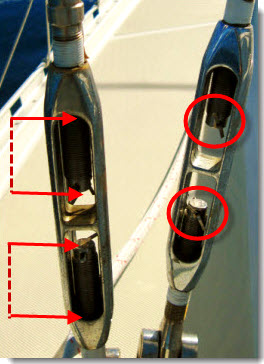
Take the First Step to Rigging Integrity
Your shrouds, stays, blocks, furling gear, boom vang, and mast and boom fittings rely on one single fitting to hold them in place. If this fails, your rig could crash over the side, a block could slingshot across the deck, or your costly sails could be torn by a sudden unexpected load.
These tiny rigging warriors pin your rigging parts together, just like the nuts and bolts in an automobile. They are under constant load to deal with the stress, strain, and vibration imposed on your rigging as you sail. So who are these champions of your sailboats rigging?
Often overlooked--sometimes with catastrophic results--the common cotter pin leads the pack as the single most important part of your standing rigging. These fasteners can be bought for less than $1 at any nautical hardware store.
Cotter pins come in two varieties--cotter rings and cotter pins. Banish the "key ring" shaped cotter rings from your sailboat rigging for good. They have a nasty reputation of backing out of a fitting from vibration or stress. Carry and install "bobby-pin" shaped cotter pins for strength, durability, and super sailing security.
Inspect Your Rigging with Care
Follow this fast, easy inspection to check the most vital parts of your standing and running rigging. Check the turnbuckles and cotter pin integrity on each stay and shroud first. Start at the bow with the headstay. Work your way down the side to the upper and lower shrouds, then to the backstay, over to the other side, then forward to the bow.
Look for dishing, or distortion of the turnbuckle barrel or the stay or shroud end fitting. Once a barrel or end fitting has distorted, it cannot be bent back into place without weakening the damaged area. Do not set sail unless all fittings appear straight and true.
Pay particular attention to the top of each stay or shroud turnbuckle where the end fitting enters the turnbuckle barrel. This area can trap water and develop hairline fractures over time.
Look inside the turnbuckle body (see illustration above). Check for cotter pins on the threaded end fittings. Make sure that you can see at least ½" of thread inside the turnbuckle body. Each shroud or stay needs at least that much threaded end so that you can replace the cotter pins or tune the rigging.
Replace a Cotter Pin the Right Way
Check that each cotter pin has been sized to the hole of each individual fitting, and shaped in the correct way. You need to be able to pull the cotter pin out for replacement, or in an emergency. Follow this easy process:
Five Steps to Replace a Cotter Pin
1. Use a cotter pin that fits snug in the fitting hole.
2. Push the pin into the hole as far as possible.
3. Shorten the legs to 1½ times the fitting diameter.
4. Spread the legs into a "V" shape.
5. Leave the cotter pins un-taped for instant inspection.
If you decide to tape over the cotters on shrouds or stays, use just enough rigging tape to cover the cotter pin (two or three wraps about 1" wide). This allows easy removal and inspection.
Other sailing rigging fittings with cotters
Make sure you check these common sailing running rigging fittings. Replace all missing or distorted cotter pins. Your sailboat will have additional components not included here. Add to this list as you go through your inspections:
- Furling drums, swivels, and fittings
- Lifeline turnbuckles
- Boom vangs
- Mainsheets
- Traveler control blocks
- Running backstays
~~~~~~~~~~~~~~~~~~~~
Now you know the first step to inspect your standing rigging for integrity and worry-free sailing. Learn more about how to inspect, protect and maintain your costly sailboat rigging, sailing sheets and lines, blocks, and much more in the highly popular member's eBooks Sailing Skipper's Pre-Sail Guidebook and Sailing Skipper's Boat Check Sheets by Captain John.
===========================================================================================
"Ask the Detailer" ~ How to Get Rid of Streaks and Spiders!
 "Ask the Detailer" is written by Natalie Sears, owner of Deckhand Detailing in Seattle WA. Natalie is the author of "The Insider's Guide to Boat Cleaning and Detailing". Visit her highly informative website at www.DeckhandDetailing.com for resources, product reviews and ask questions on how to keep your boat hull, deck and teak in tip top shape all sailing season long.
As a boat detailer who's been in business for a long time, I receive questions from boat owners on a regular basis covering all sorts of different cleaning and detailing topics. This month in "Ask the Detailer", I answer questions about black water streaks, salt water wash downs, spiders and removing marks in gel coat.
Q: I just had my boat waxed, which removed all the black water streaks, but it's only been a few weeks and now most of them are back. Why are they back on a freshly waxed boat?
A: Black streaks are made by rain water that runs down your boat in certain areas,such as off the back corner of your canvas enclosure, from a stanchion or a windshield wiper base, just to name a few places (a very few, actually).
Any vertical surface can show black water streaks after it rains and they will come back after each time that it rains. The more dirt and particles in the rain, the darker those streaks will be. Waxing your boat won't prevent them from showing up after it rains, but it will make them much easier to wash off.
You can even wipe them away with your finger or a microfiber cloth. When you wash your boat, they'll come off with soap and water and the soft deck brush. However, as the wax wears off on your boat, those water streaks will be harder to remove, especially if you don't wash your boat on a regular basis. It usually takes about six to nine months for wax to start wearing thin and for black water streaks to become more stubborn.
The more porous the gel coat, the more likely stains, streaks and marks will "soak in" to the gel coat and require more than just a mild cleaner or soap to remove, which leads us to our next question…
Q: : Should I use a black streak remover product or something similar to remove water streaks on my boat or just stick to boat soap?
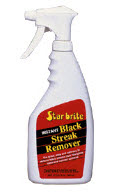
A: The answer to this question will lead you in circles until your head spins. Yes, you can use black streak remover products to remove water streaks, but over time, they will strip the wax in those specific areas and then the water streaks will become more noticeable and difficult to remove.
But if you wax your boat every year, then by the time those water streaks have become stubborn to get off because the product you've been using has completely stripped the wax in those areas, it will be time to wax your boat anyway.
Or I could have answered this question advising you to stick to boat soap, which will remove the water streaks for as long as you have a good coat of wax on your boat. Once boat soap stops removing the streaks, then you know it's time to wax your boat again. In other words, a black streak remover product is a great band-aid and will hide the symptoms, but in the end, it too will stop working and that's when it's time to wax your boat again. My advice is a happy medium solution to this.
Go ahead and use the black streak remover so your job is easier in removing those black streaks. But as soon as they become a bit harder to remove with the product, then take some cleaner wax and reapply it where the black streaks occur. This is something you can do by hand with a rag to apply it with and a rag to buff or wipe it off with. This will help your big yearly wax job last a bit longer. Another option is to use a boat soap with wax in it.
This doesn't mean that as you wash your boat, you'll be waxing it at the same time. This means that this type of boat soap doesn't strip wax and adds a light UV protectant that should last between washes to help protect your boat that much more from harmful UV rays.
Q: When I bring my boat back from being in salt water, is hosing it off good enough?
A: No. If you have just arrived at the marina and only have a few minutes before you have to rush off to your dinner reservations, then go ahead and hose it off as much as you can, spending any extra few minutes you have on windows -- both glass and plastic. But you are not off the hook. Go enjoy your dinner, but know that you still have work to do.
If it truly is evening and the sun has gone down or it's a cloudy day, then you've just bought yourself some time. But if your boat is sitting in full sun, your boat needs a lot more work than just a quick hose down. This is one of those instances where putting off what needs to be done can create permanent maintenance issues in the future. Now that I've scared you into action, you really do need to give your boat a full wash after each salt water adventure.
As soon as the sun hits your salty boat, it can burn those salty water spots into your gel coat and especially your glass and plastic windows. It can also start to rust your stainless, so time really is of the essence. Glass windows can show permanent water spots if they don't get cleaned thoroughly and properly and once the water spot has been burned into a window, it is very difficult to remove.
You can't clean it away with a window cleaner and you can't even pick it off with your fingernail. Unlike other water spots, you can actually see the edges of each spot created by salt.
So, to keep your head from spinning, wash your boat with boat soap or Salt Away and water. Hit all sections -- gel coat, non-skid, glass and plastic windows and stainless. When you're done, wipe down all windows until they're dry. You can do the same with stainless if you have time, but the windows require your attention more than anything else.
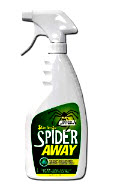
Q: The spiders at my marina are horrible. What can I do to keep them off my boat?
A: Ah yes, spiders. Not only are they creepy, but they leave little black dots everywhere on your boat -- in your non-skid, on your white vinyl seats -- everywhere! How is it possible for such a tiny creature to take over your boat almost no matter what you do to stop them! Thank goodness you can win the war over spiders, but you will need to be diligent. There is no solution that you can just set up and walk away from never to have to worry about it again. However, here are three solutions that will help you today and for a while to come.
1. Use a fogger. You can buy these at Home Depot or a similar store. They're the kind of insect foggers you set off and then run out of the room and stay away for about four hours. When you come back, all you see are dead insects everywhere -- but at least they're dead and no longer reproducing!
This is the best solution to use in an enclosed space, such as inside your canvas enclosure or inside your boat. Afterward, you will need to clean all surfaces to remove any residue and you'll want to vacuum up all the dead insects. Foggers not only kill the live insects, but their eggs, as well, so your enclosure will be spider free for about two months.
2. Use Starbrite Spider Away (or similar product). You can find the SpiderAway at any boat supply store. This is a product you can use anywhere on or around your boat. Spiders get onto your boat by climbing up your lines, so spray your lines and around the dock area, such as your dock box, fenders and the edge of your dock.
Use it to also spray around the edges of your canvas enclosure and the inside corners where they like to hide and build nests. Although it's advertised as a natural products, I still wouldn't advise breathing it in, so either cover your mouth and nose or wear a mask. If you spray this every few times you visit your boat, it will do a good job of keeping spiders at bay as it kills them soon after contact and it repels them for a few weeks.
3. Use an ultrasonic spider repeller. This is a device you can also find at a Home Depot or similar store. You simply plug it into an outlet on your boat, inside or outside, and it emits an ultrasonic sound that apparently only spiders are affected by. It disrupts their living conditions and causes them to find a less annoying home somewhere else (aka - your neighbor's boat).
This type of device works fairly well and will keep spiders off your boat for a few months, but you'll need to buy a few different brands and switch them up each time. Otherwise the spiders will get used to the frequency over time and eventually not be so disrupted by it.
=============================================================================================
Did You Miss the Latest Member's Sailing Articles?
 Simplify Sail Trim With This Secret Sailing Weapon!
May 24, 2012 ~ If you are anything like me, sailing tips that save time and sweat equity are worth their weight in gold. Pump more power and speed into your mainsail with this simple, time-saving innovation from the sailboat racing world. Use these simple sailing tips to learn how to sail with more power, speed, and performance!...
//www.skippertips.com/snip/1029.htmHow to Keep Your Costly Sailboat "Fuel Fire" Free!
May 22, 2012 ~ Dock your boat at a fuel dock and you will engage in one of boating's more dangerous, but necessary activities. Fuel fires and galley fires continue to top the "most dangerous" list of emergencies. After all, if a fire breaks out when fueling, your boat and all other boats in the marina could be exposed to a literal "lethal weapon". Follow these seven steps each and every time you fuel your boat.!..
//www.skippertips.com/snip/1028.htmSailing Safety Tips - Keep Clear of a Ship's "Blind Spot"!
May 17, 2012 ~ Learn to sail like a pro when you know the safest way to deal with one of the seas great monsters--the tanker or freighter. If you cruise along the coast or offshore, you will encounter these behemoths. Take care not to get caught inside a little known area called the "blind spot". Inside this area, you will become invisible to both visual and radar scanning. Read on to know what to do to avoid collision at sea....
//www.skippertips.com/snip/1023.htmSailing Navigation Secrets - How to Choose the Perfect Marine Binocular
May 15, 2012 ~ Few sailing navigation tools top the marine binocular when it comes to sailing safety. Matter of fact, this single item should be near the top of your "pack before you leave" list. What qualities make a great binocular? You may be surprised to know that my personal pair has proven to be superb--and it cost a lot less than $125 on sale. Read on to know what features this vital sailing tool needs to have....
//www.skippertips.com/snip/1022.htmSimple Sailboat Electronics for the Rest of Us - Part III
May 10, 2012 ~ Your boat's electrical wiring has to be the correct size to prevent heat buildup, blown panel fuses--or even a deadly electrical fire. What steps can you take to make sure that your auto pilot, compass light, navigation lights, VHF radio, bilge pumps, and chart plotter will provide worry-free operation? Follow this easy safety guide!...
//www.skippertips.com/snip/1015.htm=============================================================================================
Sailing Skipper's Quotable Quotes...
-- Captain John Repeatability is the essence of good seamanship under power or sail.
What works today should work tomorrow on my boat, your boat, or any other boat out there--without a whole lot of fuss.
from 'Seamanship Secrets'
Get Instant Access to 600+ sailing articles, 125+ sailing skills videos, 175+ sailing newsletters and ezines, 14 FREE eBooks, live discussion forums and more! Click Here to Join! Recommended Reading for Sailing Season 2012! "SEAMANSHIP SECRETS"
from International Marine / McGraw-Hill
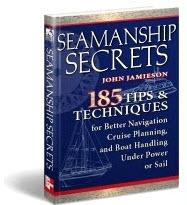 "You will be in the hands of an experienced and trusted guide."
-- Daniel Spurr, former senior editor of Cruising World magazine"Written so clearly that navigation and seamanship will be comprehensible to anyone."
-- Dave and Jaja Martin, circumnavigators and authors"It should be read by anyone contemplating coastal cruising or
blue water voyages."
-- Ted Brewer, famed yacht designer and veteran cruising sailorCaptain John Shares 25+ Years of Experience to Show You How to...
- Complete 90% of your navigation--before you cast off the lines.
- Determine the best "window of opportunity" to transit any inlet.
- Enter an unfamiliar harbor after dark in complete confidence.
- Extend the trouble free service of any size inboard diesel engine.
- Balance any sailing vessel in heavy weather in three easy steps.
- Use "terrain effect" to forecast weather anywhere in the world.
- Control boat emergencies with a simple method called M-A-T-E.
All this and much more. 326 pages tailored to short-handed sailors and crews.
Easy to read and loaded with crystal clear illustrations. Get your copy today!Click On One of These Links to Order Now!
 "Ask the Detailer" is written by Natalie Sears, owner of Deckhand Detailing in Seattle WA. Natalie is the author of "The Insider's Guide to Boat Cleaning and Detailing". Visit her highly informative website at
 Simplify Sail Trim With This Secret Sailing Weapon!
 "You will be in the hands of an experienced and trusted guide."
 ,