


In Today's Issue:
* It's Your Call, Skipper!
* Sailing Skills Video-of-the-Week
* Did You Miss These Latest Member's Sailing Articles?
* Sailing Skipper's Quotable Quotes
=============================================================================================
"It's Your Call, Skipper!"

How many times have you found your boat dinghy tough to control in wind or current? Do you know the three approach choices you can make for a perfect landing every time? Follow these easy steps in any marine weather to bring your dinghy alongside smooth and easy.
Equip Your Dinghy Before You Go!
I recently visited a local marina and walked past the dinghy dock. All twelve dinghies had outboard motors.But only one had a pair of oars and just two had an anchor aboard!
Many sailing skippers rely on outboard motors, but these can fail when you least expect it. Now what, skipper?
Equip your dinghy with stout oarlocks and a proper set of aluminum or wooden oars. Carry a small, light-weight anchor on all rope rode in case your engine breaks down (see "Related Articles" below for more on equipping your dinghy).
Match the Approach to the Elements
Your small cruising boat will be lying at anchor with the bow pointed into the stronger of either wind or current. Whether you use an outboard or oars, you will always have three approach choices for landing alongside.
This list shows approaches from the most desirable to the least desirable:
- Downwind approach
- Crabbing across the wind
- Upwind approach
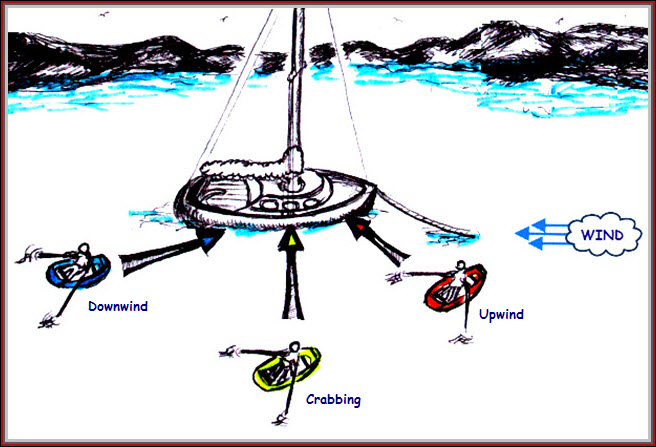 Make your approach under outboard or oars in one of three ways. Use the downwind approach (blue dinghy) for greatest control. Select the crabbing approach (yellow dinghy) or upwind approach (red dinghy) if you want the elements to do most of the work.
Downwind Approach
Gain the most control with the downwind approach. That way, you will stem (head into) the wind and current. This puts you in command over the elements. Follow these steps:
1. Aim for a point between the beam and stern of your boat. This area--called the "quarter"--will provide the lowest amount of freeboard (distance from the deck to the waterline) for easier boarding--with or without a ladder.
2. Keep the dinghy headed into the wind or current at a narrow angle. In a chop, meet the waves at a slight angle instead of head-on. This provides a smoother ride and your passengers will stay drier.
3. Tie off a bow line as soon as you land. Snug up the dinghy alongside with a stern line before de-boarding. Take care to step from the center of the dinghy if possible for safety.
Crabbing-Across-the-Wind Approach
1. Aim the dinghy for a point between the bow and beam of your small cruising boat. Concentrate on a single point, such as a port, shroud, or some other fixed, easy-to-identify object. You will use this focal-point in the crabbing technique.
2. Keep the dinghy angled 45 degrees into the wind or current. Look over your shoulder; concentrate on your chosen focal-point. Use just enough power (engine or oars) to allow the dinghy to set down onto the beam of the boat.
3. Tie off a bow line as soon as you land. Snug up the dinghy alongside with a stern line before de-boarding. Take care to de-board as described earlier.
Upwind Approach
1. Aim for your boat's bow or anchor rode. This provides you with a good reference point.
2. Keep the dinghy headed into the wind or current at a narrow angle. If you find the boat setting down too fast, use more power (engine or oars).
3. Tie off a bow line to the anchor rode or the bow of your cruising boat. The dinghy will blow down alongside. Snug up the dinghy alongside with a stern line before de-boarding.
~~~~~~~~~~~~~~~~~~~~~
As a sailing skipper, you need to know different ways to land a boat dinghy alongside your anchored cruising boat. Use these tips to make safe, controlled dinghy approaches in any wind or current.
=============================================================================================
Captain John's Sailing Skills Video-of-the-Week
Do you know the three vital factors for peace-of-mind anchoring?
Without these, your anchor could drag when you lease expect it.
Make sure that you have enough anchor line or chain out...
to hold your small sailboat safe and sound throughout the night.
Watch this exclusive sailing skills video now.
How Much Anchor Line Do You Need for Safety?
=============================================================================================
Did You Miss the Latest Member's Sailing Articles? The Non-Electrician's Easy Guide to Boat Electricity - Part II
April 26, 2012 ~ Do you know how much battery power you require to run the electronics aboard your small sailboat? Or how many marine batteries you need to carry for worry-free day sailing or cruising? Captain Doug Gardner shows you the basics in Part II of this exclusive series...
//www.skippertips.com/snip/1001.htm Sailing Navigation Secrets - Use S.T.O.P. to Find Your Way!
April 24, 2012 ~ I got snookered one night when I confused a lighted buoy for a light structure. Both aids showed similar light characteristics and were within 100 yards of each other. As we proceeded south, we kept the flashing light ahead just off the starboard bow. Suddenly, our spotlight picked up the reflective tape of the light, 50 yards off the port bow!..
//www.skippertips.com/snip/1000.htmSailboat Electronics for the Non-Electrical Sailor Part I
April 19, 2012 ~ Today's sailor uses electronics for navigation, lighting, engine starting, refrigeration, and heating. How can you keep this expensive sailing gear trouble-free in a wet, salty sailing environment? Skippertips member and electrician Captain Doug Gardner shows you how in Part I of this exclusive member's series...
//www.skippertips.com/snip/989.htmSailing Knots Secrets - Keep Line Leads Straight and "Wear Free"
April 17, 2012 ~ Sailing rope costs are going up like most everything else. And you will want to extend the life of your expensive halyard, outhaul, reefing, and other running rigging lines as long as possible. Follow this easy sailing tips secret to success...
//www.skippertips.com/snip/988.htmKeep Your Sailboat Engine in Top Shape with Liquid Gold
April 5, 2012 ~ What single component of your diesel engine performs like an athlete to keep your engine running like a top? It removes heat, lubricates bearings, traps dirt and sludge. And it's also ignored more often than not. Keep your expensive marine diesel roaring like a lion season after season with these secrets from diesel engine master mechanic Nigel Calder....
//www.skippertips.com/snip/967.htm=============================================================================================
Sailing Skipper's Quotable Quotes...
-- John Vigor, The theory of anchoring is one thing...the practice is quite another.

from 'The Seaworthy Offshore Sailboat'
Get Instant Access to 600+ sailing articles, 125+ sailing skills videos, 175+ sailing newsletters and ezines, 14 FREE eBooks, live discussion forums and more! Click Here to Join! Recommended Reading for Sailing Season 2012! "SEAMANSHIP SECRETS"
from International Marine / McGraw-Hill
"You will be in the hands of an experienced and trusted guide."
-- Daniel Spurr, world famous author and former senior editor of Cruising World magazine."Written so clearly that navigation and seamanship will be comprehensible to anyone."
-- Dave and Jaja Martin, circumnavigators, authors and stars of the documentary "Ice Blink"."It should be read by anyone contemplating coastal cruising or blue water voyages."
-- Ted Brewer, world famous yacht designer, veteran ocean racing and cruising sailor."It's a great book. The prose is simple and clear."
-- John Vigor, acclaimed author of 12 sailing books and cruising sailor".Captain John Shares 25+ Years of Experience to Show You How to...
- Complete 90% of your navigation--before you cast off the lines.
- Determine the best "window of opportunity" to transit any inlet.
- Enter an unfamiliar harbor after dark in complete confidence.
- Extend the trouble free service of any size inboard diesel engine.
- Balance any sailing vessel in heavy weather in three easy steps.
- Use "terrain effect" to forecast weather anywhere in the world.
- Control boat emergencies with a simple method called M-A-T-E.
All this and much more. 326 pages tailored to short-handed sailors and crews.
Easy to read and loaded with crystal clear illustrations. Get your copy today!Click On One of These Links to Order Now!
-
Amazon, Barnes & Noble, or Books-a-Million
 The Non-Electrician's Easy Guide to Boat Electricity - Part II