
The #1 Sailing Knot and How to Tie It!
The Genoa sheet was jammed on the primary winch. And no one in our crew could pull the buried sheet out of the turns. Gripped like a barnacle on a boat bottom. We tugged and pulled. Nothing doing. Nada. That jam would not budge. And there was just one sailing knot we knew of that could solve this problem fast, smooth and easy!

Enter the most forgotten sailing knot of all--the mighty Rolling Hitch. It was the perfect knot to use to the solve our sailing problem. We grabbed a spare length of line, tied a fast rolling hitch onto the sheet, took the spare line to a secondary winch and applied tension on the spare line to free up the sheet.
Within seconds we had unwrapped the frozen turns and were sailing again, bound for the blue-green waters of the Caribbean! What marine knot would you guess would win the award as the most versatile of all? Which marine knots would you bet your life on if you were aloft at the masthead--and the main halyard failed?
Not many knots can be tied or untied under strain. Or loosened when wet. Or will hold in place without slipping on a wet rail or spar. Or save your life when other less worthy knots might give way. Check out this short list of uses for the super reliable rolling hitch...
Now, there are many alternative versions of the original Rolling Hitch (i.e. the Rigger's Hitch and the Camel Hitch). But the original Rolling Hitch stands apart as the easiest to tie, adjust, and can be repositioned up or down a length of rope, rail, spar, or lifeline with one hand. Which in my mind, makes it just about as valuable as they come.
As you will see, the critical part of the hitch will be the way it's started and ended. Remember this vital fact with any sailing knot you tie--knots often fail because of slack (looseness). When you finish tying a knot, remove all slack. This will help keep the knot from spilling (untying itself) . Take the extra 2-3 seconds to remove the slack.
Grab some line and tie along with the steps and illustrations below.
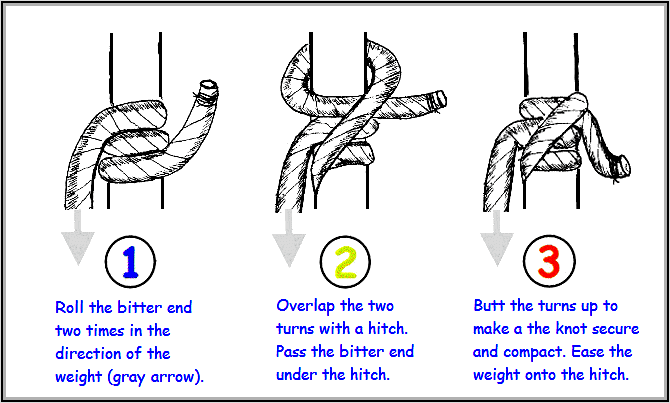
How to tie the R-O-L-L-ing hitch
Use the memory key R-O-L-L to remember the steps to tie a rolling hitch. Practice these four steps until you can tie it without looking:
R -- Roll toward the load
Start the hitch with two round turns in the direction of the weight (load). If you are the weight, roll the first two turns toward you (illustration 1).
O -- Overlap the first turns
Make the "hitch" with a pass over the first two turns in a direction away from the load (illustration 2).
L --Loop under the hitch
Pass a loop beneath the hitch, just like you would with a clove hitch (illustration 2). Add additional half hitches for even greater security.
L -- Lower the load slow and easy
Butt up the turns next to one another (illustration 3). Then, ease the weight onto the hitch in a smooth motion. Take care not to jerk or shock the load.
~~~~~~~~~~~~~~~~~~~~
Captain John's Sailing Tip
Work the slack out of any sailing knot after you finish tying it. Hold the bulky part of the knot. Next, pull on the bitter ends and standing part. Slack compromises safety. Make it tight to make it right!
~~~~~~~~~~~~~~~~~~~~
Follow these simple sailing tips to tie one of the most powerful, reliable sailing knots in all of sailing. This valuable knot could "save the day" sometime in the near future--wherever in the world you choose to cruise!
365+ sailing newsletters, 20+ FREE eBooks, and much more.
Click here to Find Out More!