

In Today's Issue:
* It's Your Call, Skipper!
* Sailing Skills Video-of-the-Week
* Sailing Master Secrets ~ Waterproof Your Mobile Phone at Sea!
* Did You Miss These Latest Member's Sailing Articles?
* Sailing Skipper's Quotable Quotes
=============================================================================================
"It's Your Call, Skipper!"
These Sound Signal Sailing Tips Could Save Your Life!
You may think that low visibility applies to fog bound boats deep in the cold waters of New England, northern California or other foggy areas. But did you know that even in the Caribbean, you can have similar conditions that require immediate action? Keep your sailing crew safe and sound when you know the lights and signals for sailing in tough conditions!
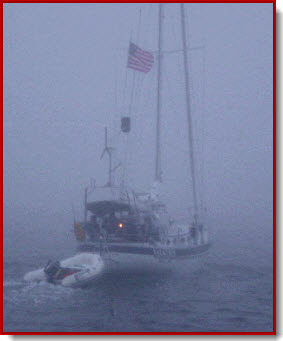
Are you In or Near Low Visibility?
Fog, haze, rain, sleet, snow, sand, squalls, or even in heavy weather conditions with heavy spray all constitute low visibility. Look at low visibility from the other vessel's point of view. If they are unable to detect you, then you are vulnerable to collision.
How can you best make your presence known to all other vessels around you? Surround your vessel with a "cone of light and sound" protection.
Indeed, that's just what the Navigation Rules require you to do. And after all, it's for your protection and the protection of the other vessels out there that you may not be aware of.
Remember this; not all vessels have AIS and not all vessels have radios. Nor do they all have radar. Some watchstanders are not alert, fail to make visual scans, and rely too much on electronic alarms to warn them of danger. And this includes professional licensed skippers too! In addition they may never pick you up on radar--and here's why...
Sailboats make poor radar targets. Hulls are low to the water. Masts, booms, and sails give poor reflective signal returns. Radar reflectors might do well in tests, but atmospheric conditions, heeling, and sea state can give spotty radar returns.
Sea and rain clutter on a radar can look like hundreds of targets. In the end, you must make great effort to make your vessel "visible" by other means, such as proper navigation lights and sound signals.
When to Sound Low Visibility Signals?
Imagine that you are in San Francisco Bay on a clear and sunny sailing day. Where you are sailing, visibility could not be better. But a half mile ahead, you see a fog bank. You will sail around the fog bank to avoid it.
Yet, the Navigation Rules that govern collision avoidance require you to sound low visibility signals (sometimes called "fog signals") right away. You want to warn anyone underway inside the fog bank of your presence. Not by radiotelephone. But by the proper signal for a sailing vessel underway (or--if under power--you are considered a power-driven vessel) in or near an area of low visibility.
Sailing or Under Power?
 In or near an area of restricted visibility, whether day or night, the signals prescribed in this Rule shall be used...

What lights and sound signals are you required to use? This depends on whether you are under sail alone or under power (which includes under sail and power--or motor-sailing). If you are under power, the Rules consider you to be a power-driven vessel. Power-driven vessels give different signals and show additional lights (see table below).
There have been arguments that while charging batteries with sails hoisted and the engine on but the shifter not engaged (in forward or reverse propulsion), you were still a sailing vessel.
But consider the point of view of another vessel that sees your exhaust spitting water. The other vessel could assume that you are now under power, and no longer just under sail. In the event of a collision, you might have a tough time proving in Admiralty court that you were under sail alone if you have your engine on.
Lights and Signals You Need to Know
Use a hand held horn or air-canister device to give sound signals. The Rules define blast duration as "prolonged", which means 4 to 6 seconds and "short" which means 1 second.
Give combinations of blasts in succession. For example, if you are required to sound one prolonged and two short blasts, you would sound a prolonged blast for four to six seconds immediately followed by two short blasts of about one second duration each.
Underway making way means you are being propelled through the water by some means--sail, engine, oars. Underway not making way means you are stopped and drifting.
Look over this table of sound signals and lighting requirements for vessels under sail or power. Note what you must do when you operate your sailboat under sail and power or power alone.
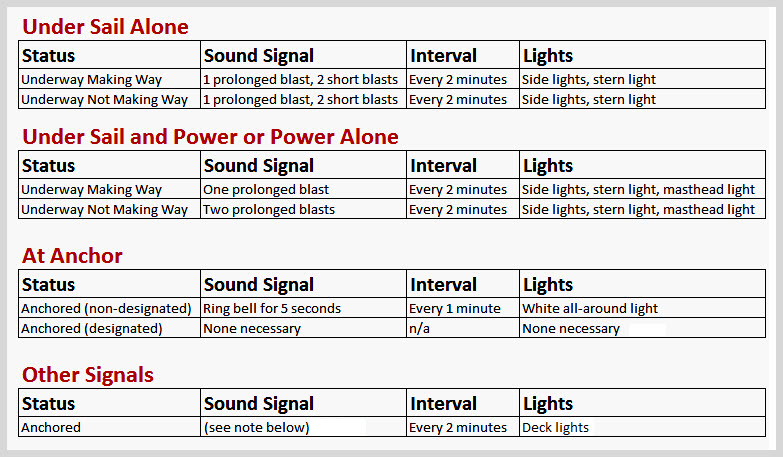
*NOTE: You are not required to sound the bell at anchor if you are less than 12 meters (39.4 feet) in length. But you must give some signal at intervals of not more than 2 minutes. The signal must be unique and not used anywhere else in the Rules. One suggestion is to sound 1 short-1 prolonged-1 short blast every two minutes to warn others of your position.
Nor are you required to sound the bell at anchor in a designated anchorage or mooring area. Designated means an area specifically set aside by authorities for anchored vessels (i.e., a mooring field).
~~~~~~~~~~~~~~~~~~~~
Put these sailing tips into play aboard your sailboat when sailing in or near restricted visibility. Keep your day sailing, cruising and voyaging sailing crews safe and sound--wherever you choose to cruise!
Members can download the entire 218 page book of fully illustrated Navigation Rules that can be used anywhere in the world. Click here => Navigation Rules Download
=============================================================================================
Captain John's Sailing Skills Video-of-the-Week
powerful enough to hold the largest sailboat...
safe and secure in her slip or alongside a pier...
and do this in just ten seconds or less?
Grab a piece of sailing rope now and follow along...
as you watch this exclusive sailing skills video...
Make Sailing Knots Safer in Just Ten Seconds!
Mobile Device Users.
Click on the link above. Click on the icon beneath the main screen.
Please allow 20 to 30 seconds for the video to upload.
=============================================================================================
Sailing Master Secrets ~ Waterproof Your Mobile Device at Sea!
 Today, Norwegian sailor Jon Amtrup, cruising expert and publisher of TheSailNews shows you a new innovation for sailors from New Zealand that will keep your IPhone or other mobile device waterproof and in good shape in rain, spray, or storms when cruising.
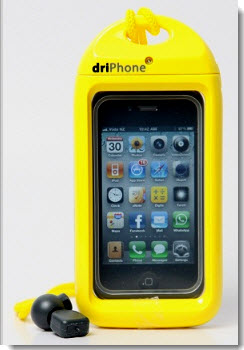
iPhones don't mix with the marine environment. But with the new innovation from New Zealand called the driPhone cover, you can keep your favorite phone dry and safe through any storm.
The driPhone comes in three different colors: Yellow, black and white. The yellow casing is my favorite as it makes the phone very easy to spot.
An iPhone can be a useful tool while sailing on the coast. You can check the weather forecast, navigate, find port information, restaurants and more. The list of useful apps for sailors is almost endless.
But saltwater, rain and a bumpy ride aren't the best of friends with the iPhone. I have ruined PC's, Mac's and phones out sailing. The learning process has been expensive. So now I am very keen on getting the right kind of protection for my delicate machines.
One such item is the driPhone from New Zealand. The cover is 100 percent waterproof and will keep your iPhone dry for a six meter dive. It should actually be possible to take pictures underwater with your mobile if you are using this protection.
driPhone has also a thick plastic cover on the side of the phone that provides protection against stroke. The touch-screen is fully functional while protected by a thin plastic film.They also make an Android version of the cover and soon will launch the iPad version.
Find out more here => DriPhone Covers.
=============================================================================================
Did You Miss the Latest Member's Sailing Articles?
 Learn to Sail Like a Pro in Restricted Waters
March 29, 2012 ~ f you are anything like me, nothing beats the challenge of sailing through a tight area under sail alone. Learn how to do this safe and easy. Follow these five sailing tips used time and again by single handed and short handed sailors for sailing success...
//www.skippertips.com/snip/958.htm
Docking a Boat Safety Tips - Beware of the "Bight-Line"!
March 27, 2012 ~ How can you keep your boat or sailing crew safe when working a docking line under high tension? Make sure you put these three golden safety rules into play right away aboard your small sailboat today!
...
//www.skippertips.com/snip/957.htm
Sailing Navigation Secrets - How to Customize Your Charts for Sailing Safety
March 25, 2012 ~ Do you find it difficult to read your navigation chart at night or in rainy sailing weather? Would it make things easier to highlight dangers, anchorages or lighted buoys along your sailing routes?
...
//www.skippertips.com/snip/956.htm
Ten Tips to Make Your Marine Head "Cruising" Ready!
March 22, 2012 ~ Are you sure that your marine head will stand the test of coastal cruising or extended voyaging to distant lands over the horizon? Follow this sound advice from world famous author and cruising veteran Nigel Calder....
//www.skippertips.com/snip/948.htm
Docking a Boat Secrets - Back Out of a Slip Single-handed!
March 20, 2012 ~ How do short-handed crews undock their small cruising boats--without any help from line handlers ashore? Did you know that you can undock any size sailboat from inside a narrow slip with just one line--even in a stiff cross wind or cross current? Follow these seven easy steps to success!...
//www.skippertips.com/snip/947.htm
=============================================================================================
Sailing Skipper's Quotable Quotes...
The book of 'Navigation Rules' is in many ways the most important book in navigation. Every prudent mariner should know it well.
master mariner and world renowned author