

In Today's Issue:
* It's Your Call, Skipper!
* Sailing Skills Video-of-the-Week
* Sailing Master Secrets ~ Discover the "Wrap-Around" Storm Jib
* Did You Miss These Latest Member's Sailing Articles?
* Sailing Skipper's Quotable Quotes
=============================================================================================
"It's Your Call, Skipper!"
How to Choose and Use a Bulletproof Storm Jib!
Remember that storm jib you bought with the boat? When was the last time you hanked it, hoisted it, and tested it? Many sailors never have, and this highly specialized boat sail gets left in a sail bag--until extreme conditions call for an exit strategy!
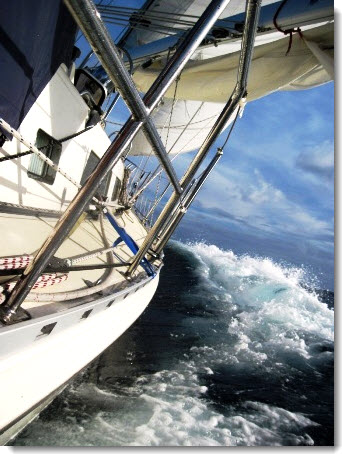
But if you don't know what it takes to rig it, you will be in a world of hurt when you need it the most. Make sure you go through a drill with your sailing crew with this champion of heavy weather sailing.
Called a storm jib, spit-fire, or a #3, these special sails are made to do one thing--get you to windward when no other sail will perform the task as well.
Of course you can use them for reaching or running, but the primary emphasis will always be punching to windward.
Consider this scenario: You are in heavy going with a breeze that approaches gale force. You've allowed the boat to get a bit too close to the coast. Now you must "claw" your way to windward to gain sea-room and safety.
You may have heard the term "clawing off a lee shore". Better have the right sails for the job. And they don't exist in the form of furling sails!
The Five Part Perfect Storm Jib
1. Build with the Right Cloth Weight
Choose a "soft hand" cruising cloth instead of one with a high resin coating. Soft hand sailcloth will be easier to handle, more forgiving of chafe and flogging, and will last longer. Have your storm jib built with the right weight to take the high loads and stress of howling wind and pounding sea. Follow these specs:
Boats Less than 40 feet: Use 10 Oz. Dacron sailcloth.
Boats Over 40 feet: Use 12 to 14 Oz. Dacron sailcloth.
2. Hoist on a Separate Inner Stay
Cutter-rigged boats should hoist on the inner staysail stay (also called the forestay). Sloops that will be in exposed weather can use the head stay, but a far safer arrangement could be a collapsible, inner stay. You will need a hefty deck eye with heavy backup plates installed below to distribute the load.
You will also most likely need additional stays or running backstays to support the tensioned inner staysail stay. Check with your manufacturer, sailmaker, and rigger before you consider installing an inner stay aboard your sailboat.
3. Beef Up Hanks for Point Loading
Ask your sailmaker to install heavy reinforced patching for each grommet just behind the luff boltrope (the reinforcement rope sewn along the length of the luff). Expect flogging and gusting in such conditions. An occasional sea could break aboard to stress any point where the sail gets attached. So, each hank needs its own patch with a grommet punched in to take the loads and prevent tears.
4. Hollow the Foot and Raise on a Pennant
Area will be your enemy. Any foot round (extra cloth that a Genoa or jib carries outside of the straight clew-to-tack line) will flog, so a storm jib must have a bit of "hollow" on the foot.
Raise the foot with a tack pennant (also called a pendant). Make the pennant out of wire rope or high tech fiber rope with eyes on each end. Install stainless thimbles into each eye (similar to the thimble used in the eye of a rope anchor rode). Thimbles protect the wire or synthetic rope from chafe. The raised pennant protects the sail from a boarding sea and gives you better "under the foot" visibility.
5. Never, Ever Use a Furling Sail!
Under no circumstances should a furling sail be used in winds in the range of gale force or above (30+ knots). That's the fastest way to blow out a sail, risk the possibility of mechanical furling unit problems, and this places enormous side loads on the extrusion tube and sail.
There are many stories of units failing in such conditions. Blow out a furling unit with the sail part-way unfurled and you will find it difficult to lower the sail. The friction placed against the luff sandwiched inside the narrow groove of an extrusion tube makes hauling the sail down next to impossible.
But what about those furling sails used by skippers in extreme offshore races? Those are highly specialized and expensive sails custom designed for boats manned by pro crews. Keep furling sails furled in high wind conditions for sailing safety! Use a well designed storm jib made for the conditions at hand.
~~~~~~~~~~~~~~~~~~~~
Follow these simple sailing tips to learn to sail in heavy weather conditions better than ever before. Gain the confidence and skills you need to be ready to meet heavy weather--wherever in the world you choose to cruise!
=============================================================================================
Captain John's Sailing Skills Video-of-the-Week
when you know alternative ways...
to lower, flake and tie off...
any size mainsail fast and easy.
Use just one single line...
instead of multiple sail ties!
Watch this sailing skills video now...
Contain Your Mainsail with a Single Sail-Tie!
Mobile Device Users.
Click on the link above. Click on the icon beneath the main screen.
Please allow 20 to 30 seconds for the video to upload.
=============================================================================================
Sailing Master Secrets ~ Discover the "Wrap-Around" Storm Jib!
 Today, Norwegian sailor Jon Amtrup, cruising expert and publisher of TheSailNews shows you a new innovative product that allows you to hoist a storm jib faster and easier--and from the safety of the cockpit!
There is no really easy way to hoist a storm sail when the weather is bad. The key is to be prepared. And the new Storm-Bag looks like a product that can make life on foredeck and on board much easier in a big blow.
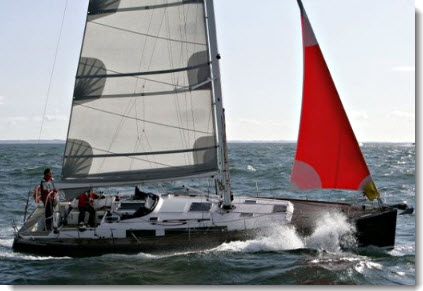
They have seen the way modern cruisers are set up with one furling Genoa and very seldom any cutter stay.
What to do when there is a big blow coming? The shape of a nearly rolled up Genoa is very seldom a good solution.
And to take the Genoa down on deck may seem like a nightmare for people who are only taking it down every autumn.
There already exists a few different solutions for rigging a storm jib, but most of them require a lot of work on the foredeck in heavy conditions. The Storm-Bag is so far the smoothest solution we have seen.
It comes folded in a yellow soft bag. Wrap it around the furled Genoa, attach the halyard, tack strop, and sheets and it is ready to be hoisted from the safety of the cockpit. The orange sail is double so it folds around the furled Genoa, and the two separate clews join together as one. Find out more here => Storm-Bag.
=============================================================================================
Did You Miss the Latest Member's Sailing Articles?
 Top Ten Sailing Tips for Sailing Season 2012!
March 15, 2012 ~ Learn to sail like a pro when you set a standard for yourself each time you cast off to go sailing. Members have asked me to put together a "best of" quick list of the top sailing tips for the just-around-the-corner sailing season. Put these ideas into play aboard your day sailor, cruiser or racer for safer and more fun sailing--wherever in the world you choose to sail...
//www.skippertips.com/snip/939.htm
Sailing Navigation Secrets - How to Find Sailing Course and Speed
March 13, 2012 ~ Learn to sail like a pro when you are able to calculate your sailboat's course and speed over ground--with or without a nautical gps or chart plotter. Put this sailing navigation technique at the top of your "must know" seamanship skills for safer sailing anywhere in the world...
//www.skippertips.com/snip/938.htm
Five Sailing Tips for Safer Sail Handling for Your Sailing Crew
March 8, 2012 ~ If you are anything like me, sailing tips that cut the time you spend at the mast or on the foredeck are always welcome. Here are five secrets from one of my past offshore passages that you will find can cut time by 50% and add to safer sailing for your crew.
//www.skippertips.com/snip/930.htm
Sailing Navigation Secrets - Use "White Water Pockets" an Emergency!
March 6, 2012 ~ You are sailing or powering down a narrow channel after a super day of sailing. All of a sudden out of nowhere, your engine quits. You need to get out of the high traffic channel, but which way do you turn. Shoals to the left and right. Yet, there's one little-known way to find deep water outside of a dredged channel at a glance--if you know what to look for. Follow these easy sailing tips to keep your boat and crew safe and sound....
//www.skippertips.com/snip/929.htm
Sailing Tips Secrets - Practice the Art of Heaving-to
March 1, 2012 ~ Set sail this coming season and you will want to know how your boat reacts when you need to stop for a break--under sail without holding your sailboat tiller or wheel. Follow these easy steps to learn this "must know" sailing skill...
//www.skippertips.com/snip/921.htm
=============================================================================================
Sailing Skipper's Quotable Quotes...
 Gales account for 2% or less of your sailing time, on average.

author of 'The Seaworthy Offshore Sailboat'
all at no extra cost? Click here for more information!
from International Marine / McGraw-Hill
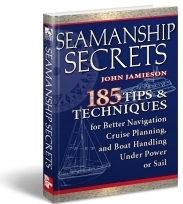
"You will be in the hands of an experienced and trusted guide."
-- Daniel Spurr, world famous author and former senior editor of Cruising World magazine.
"It should be read by anyone contemplating coastal cruising or blue water voyages."
-- Ted Brewer, world famous yacht designer, veteran ocean racing and cruising sailor.
"It's a great book. The prose is simple and clear."
-- John Vigor, acclaimed author of 12 sailing books and cruising sailor".
Captain John Shares 25+ Years of Experience to Show You How to...
- Complete 90% of your navigation--before you cast off the lines.
- Determine the best "window of opportunity" to transit any inlet.
- Enter an unfamiliar harbor after dark in complete confidence.
- Extend the trouble free service of any size inboard diesel engine.
- Balance any sailing vessel in heavy weather in three easy steps.
- Use "terrain effect" to forecast weather anywhere in the world.
- Control boat emergencies with a simple method called M-A-T-E.
All this and much more. 326 pages tailored to short-handed sailors and crews.
Easy to read and loaded with crystal clear illustrations. Get your copy today!Click On One of These Links to Order Now!
Amazon