
How Safe Is Your Sailboat for Coastal or Offshore Sailing?
Is your sailboat safe enough to sail offshore in rough seas and high winds? What simple three-step test can you make to understand your sailboat's ability to recover from a ‘knockdown'? Follow these sailing tips to learn more.
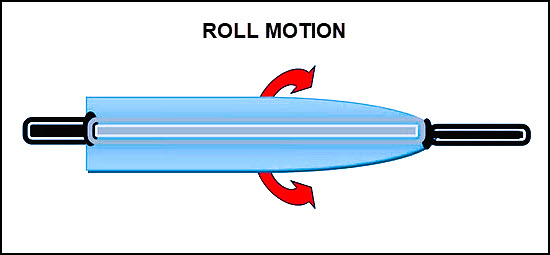
Step aboard any moored vessel, and you induce roll motion (illustration above). The roll axis lies along the centerline of the boat, extending from bow to stern. Imagine a long bar penetrates your boat from bow to stern; this is the ‘roll axis'.
A good indicator of vessel stability is the roll period test. There's nothing perfect about this test, but it will help you make a better decision for sailing outside of sheltered waters. Best of all, you can make this test right at the pier without the need to get underway. When I taught at the Chapman School of Seamanship, we went through this drill with our students during the week when I taught stability classes (stability is a big factor on some CG license exams). Follow the three easy steps below.
1. Stand with another person on the side of a vessel. Push hard up and down on the gunwale (the edge of the boat where the hull meets the deck) to get the boat rolling. You may need to do this several times, but get the boat rocking. Make sure that your hull is protected with fenders, and the mast will clear any obstructions. NOTE: Adjust your docking lines before beginning this part of the test so that the boat is free to roll right to left without constraint.
2. Step back; time how long it takes for the boat to complete one complete roll from right to left to right (or, left to right to left). Write down the period in seconds and tenths. Conduct a second test and make sure it agrees with your first test. Go to the next step to find out what to do with your results.
3. Look at your boat's sail plan (naval architect drawing) to find the ballast/displacement ratio of your vessel. Divide the weight of the ballast by the weight of the vessel. For example, if the ballast is 2,500 pounds and the vessel weighs 10,000 pounds. 2,500/10,000 = 25% (B/D ratio). Find the category below that best describes your sailboat. Use the formulas below (thanks to famed author and cruising sailor John Vigor for the 'roll period' factors and formulas below).
~~~~~~~~~~~~~~~~~~~~
Captain John's Sailing Tip:
Your sailboat's beam plays an important role in each of the stability tests below. Notice that you divide the width of your beam (in feet) by 3.3 and then multiply that result by the specific decimal factor shown.
~~~~~~~~~~~~~~~~~~~~
HEAVY DISPLACEMENT SAILBOATS
B/D ratio 25% or less.
Average roll period = (beam / 3.3) x .95
B/D ratio 25% to 35%.
Average roll period = (beam / 3.3) x .90
MEDIUM DISPLACEMENT SAILBOATS
B/D ratio 35% or more.
Average roll period = (beam / 3.3) x .85
CRUISER / RACER SAILBOATS
B/D ratio 35% or more.
Average roll period = (beam / 3.3) x .80
RACING SAILBOATS
Deep draft and low deck profiles.
Average roll period = (beam / 3.3) x .75
How close did your test come to the ‘Average Roll Period' result?
Longer-than-average roll periods:
Indicate an inherently unstable vessel. These vessels are called 'tender' or 'crank', and for good reason: they're top-heavy. Just another reason to take extra care when provisioning for a long cruise. Any weight added above the bilge can affect stability, so keep weights low, close to the centerline, and evenly distributed port and starboard.
Shorter-than-average roll periods:
Indicate excessive stiffness. These vessels give an uncomfortable ride with short, snappy rolls and can cause fatigue and even injury in some extreme cases. Few vessels are specifically designed to be stiff (Coast Guard surfboats have to be designed with excessive stiffness so they can recover after a severe knockdown in surf or breaking seas).
~~~~~~~~~~~~~~~~~~~~
Now you know how to make an easy three-step test to get a rough idea of your vessel's stability. Use simple tips like these for safer sailing wherever you choose to sail or cruise.
Captain John served for over twenty years in the US Coast Guard as a navigator, search and rescue skipper, ship driver, and master training specialist. Later, he directed the Seamanship and Chart Navigation departments at the Chapman School of Seamanship in Florida. He is the author of Seamanship Secrets, Captain John's Sailing Skills Series, and Captain John's Boating Safety Secrets. He has written for Blue Water Sailing, Good Old Boat, Mauri Pro Sailing, and Sail Universe.